How to Build a Capsule Wardrobe in India
A capsule wardrobe is a small, intentional collection of pieces that all work together — so every item combines with every other, and you can create a complete outfit for any occasion without effort. For Indian women, a capsule wardrobe is more complex than the standard Western model because it must span both western and ethnic wear. This guide covers the piece counts, categories, colour strategy, and ethnic wear integration specific to an Indian lifestyle.
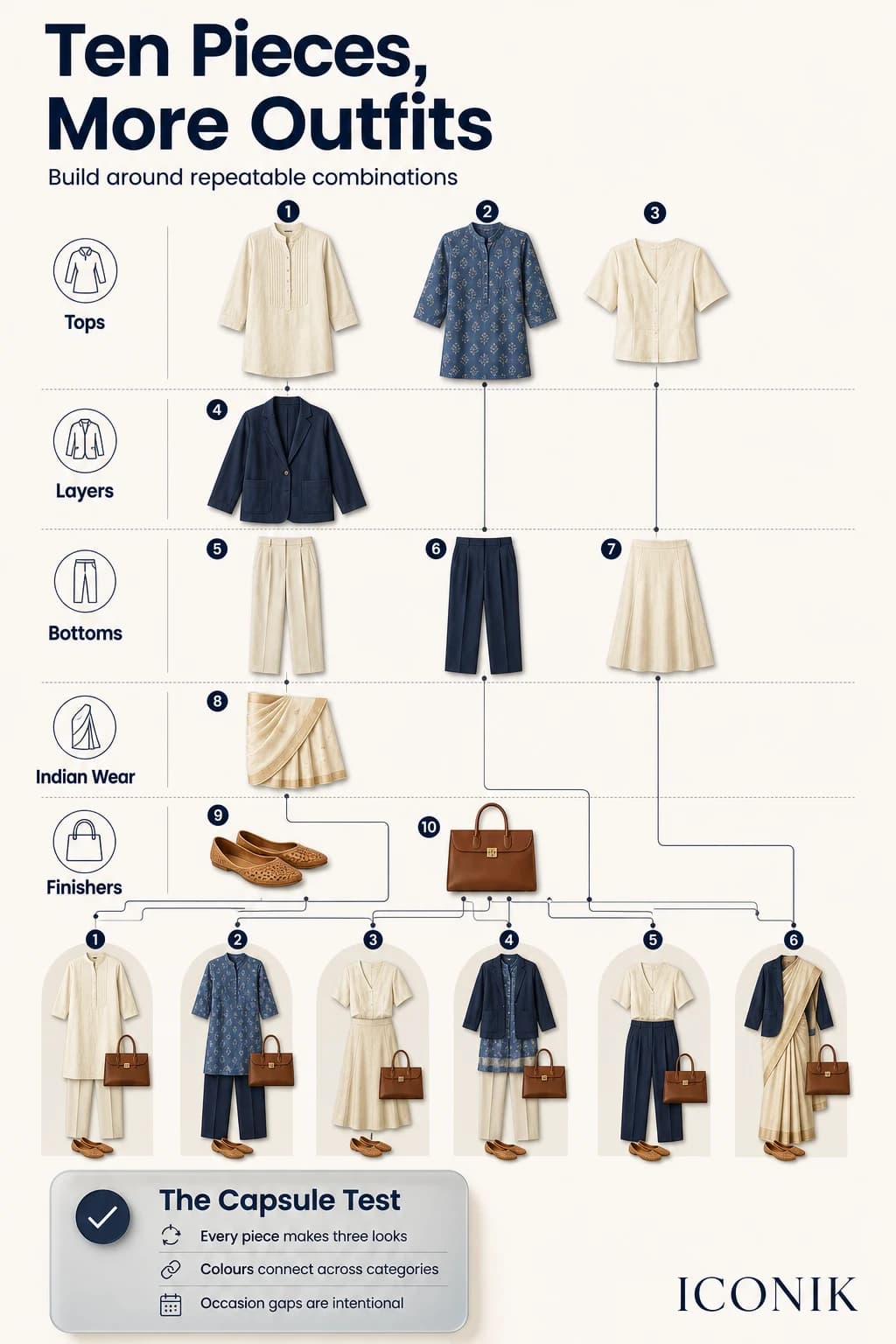
The 6-Step Process
Identify your undertone and colour palette
A capsule wardrobe only works if every piece can combine with every other piece. The most reliable way to ensure this is to build around a consistent colour palette — a set of 2–3 neutrals and 3–4 accent colours that all harmonise with your skin undertone. Without this foundation, you end up with pieces that don't combine, which is exactly what a capsule wardrobe is trying to avoid.
Audit what you already own
Before buying anything, identify the pieces you already have that fit your body well, suit your colours, and are in good condition. These become the foundation of your capsule. Most women find they already own 30–50% of what a functional capsule needs — the problem is that the remaining 50–70% doesn't work with those pieces because there is no colour or silhouette system tying them together.
Define your actual lifestyle categories
The traditional Western capsule wardrobe (office, casual, evening) does not map to most Indian women's lives. Define your actual categories: corporate office, business casual, smart casual, festive/social, traditional formal (weddings, pujas), and everyday home. Assign a rough percentage to each based on how often you need that category — then build your capsule proportionally.
Build your western wear core
Western core pieces: 3–4 fitted tops in your neutral palette, 2 trousers (one formal, one casual), 1 pair of dark jeans, 1 formal dress or skirt, 1 blazer. These should all work within your colour palette so any top can be worn with any bottom.
Build your ethnic wear core
Indian ethnic core pieces: 2–3 everyday kurtas, 1–2 churidar or straight pants to pair with kurtas, 1–2 sarees for semi-formal occasions, 1 lehenga or formal Anarkali for weddings, 1 salwar suit for versatile wear. Ethnic wear in your colour palette ensures it all combines and looks considered rather than random.
Fill the gaps strategically
Once you have audited and built the core, identify what is missing: a specific occasion you are under-prepared for, a colour that is missing from your palette but needed, or a garment type you own in poor condition. Buy only to fill these specific gaps — not because something is on sale or because you like it in isolation.
Core Categories and Piece Counts
A functional Indian capsule wardrobe typically contains 30–45 pieces — more than a Western capsule because of the dual western/ethnic requirement. Here is the recommended breakdown:
| Category | Count | Examples |
|---|---|---|
| Western neutral tops | 3–4 | White, cream, or soft grey fitted blouses; a simple black top; a neutral-coloured shirt |
| Western bottoms | 2–3 | 1 formal trouser, 1 straight-leg casual trouser or dark jeans, 1 skirt (optional) |
| Western formal/layer | 1–2 | 1 blazer or structured jacket, 1 formal dress or jumpsuit |
| Everyday kurtas | 2–3 | In your colour palette — cotton or linen for everyday wear, can be worn with jeans or churidar |
| Ethnic bottoms | 2 | 1 churidar or fitted salwar, 1 palazzo or straight pants — both in neutral shades |
| Semi-formal sarees | 1–2 | A silk or georgette saree for office events or social occasions |
| Formal ethnic (bridal/wedding) | 1 | A lehenga, formal Anarkali, or heavy silk saree — in your strongest colour |
| Casual Indian wear | 1–2 | Short kurtis or co-ord sets for casual social occasions |
The Colour Strategy
A capsule wardrobe functions because its pieces combine. The mechanism that makes them combine is a consistent colour palette. Build yours around:
2–3 Neutrals (the backbone)
Colours that pair with everything else in your palette. For warm undertone: cream, camel, warm grey or taupe. For cool undertone: white, charcoal, cool navy. For neutral undertone: off-white, greige, warm grey.
3–4 Accent colours (from your undertone palette)
Colours that are most flattering for your specific undertone — see the Colour Analysis guide for your palette. All accent colours should work with all your neutrals, and ideally with each other.
1 Standout formal colour
For your best formal piece (bridal wear, wedding lehenga, statement saree) — your strongest undertone colour at full saturation. This is the piece you wear when the occasion demands your most considered look.
Related Guides
Build your capsule around a professional colour analysis
The Iconik Style Blueprint gives you your exact colour palette (10 colours calibrated to your undertone), body type analysis, and 20 outfit formulas — the complete foundation for a capsule wardrobe that actually works.
Get My Style Blueprint — ₹2,699