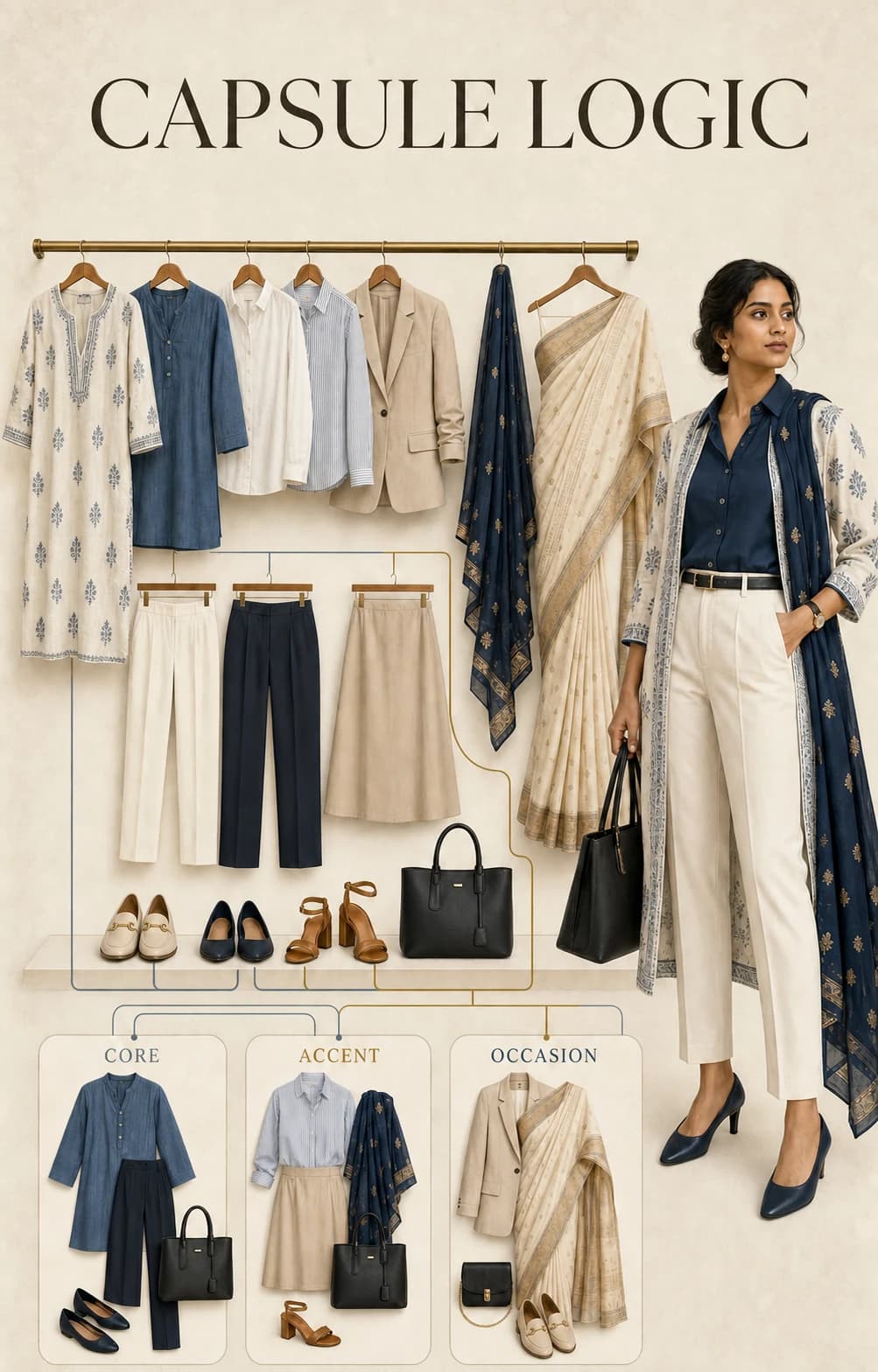
What an Indian capsule wardrobe should do
A capsule is a deliberately limited set of garments that produces enough complete outfits for a defined period or context. The important words are complete outfits. Fifteen attractive pieces are not a capsule if five require different shoes, bras, tailoring or layers that you do not own.
Your capsule can include kurtas, sarees, trousers, shirts, dresses, dupattas and fusion layers. It does not need to look minimalist. It only needs a clear internal logic.
Start with the calendar—not the shopping list
Answer these questions using the last four ordinary weeks:
- How many days each week require office, uniform or client-facing clothing?
- How often do you wear kurtas, sarees or fusion outfits in ordinary life?
- How much heat, humidity, rain or air-conditioning must the clothes handle?
- How often can you realistically wash, steam, iron or dry-clean garments?
- Which social, religious or family occasions recur often enough to plan for?
Convert the answers into outfit demand. Someone in a five-day corporate role may need eight to ten work formulas in rotation. Someone working from home with frequent family events may need fewer work pieces and more polished Indian separates.
Build three layers: core, accent and occasion
Core
These are the repeatable shapes and neutrals that support several outfits: trousers, everyday kurtas, shirts, a useful layer, and practical footwear. Core does not have to mean black or beige; navy, olive, chocolate, charcoal or deep teal can function as neutrals.
Accent
Accent pieces create identity: a printed dupatta, bright blouse, textured layer, jewellery or a lead colour. Repeat part of the accent elsewhere so it connects instead of becoming a one-outfit purchase.
Occasion
Include frequently worn sarees, festive sets or formal pieces if they share blouses, jewellery, bags or footwear with the rest of the wardrobe. Store rare ceremonial garments separately and document what each one still needs.
Build your first 12–18 piece capsule
Use the range as a starting point, not a target. Exclude underwear, sleepwear, workout clothing and highly specialised ceremonial garments.
- Keep two to four lower garments that fit now and cover your main contexts.
- Add five to seven tops or kurtas that work with at least two of those bottoms.
- Add one or two layers for office air-conditioning, weather and outfit polish.
- Add one Indian occasion route such as a saree plus reusable blouse or a coordinated kurta set.
- Add two footwear routes that cover the majority of hemlines and walking needs.
- Add accessories last to connect colour and change formality.
The exact distribution should follow the calendar. Do not add a blazer because capsule lists always include one if your work and climate never require it.
Run the ten-outfit test
Before buying anything, create ten complete outfits from the proposed capsule. Include underwear requirements, shoes, bag, jewellery, layer and weather needs.
- Photograph each outfit from the same distance.
- Record the context it covers.
- Mark pieces that appear in at least three successful outfits.
- Mark pieces that create repeated fit or care problems.
- Identify the smallest number of missing links.
A garment that works once may still deserve a place if that one context matters. The goal is not maximum combinations at the expense of identity.
Shop only the gaps
For every proposed purchase, complete this sentence:
This piece completes these three outfits for these two real contexts, and I already own the required shoes, layer and care routine.
If you cannot complete it, save the item instead of buying it immediately. Check fit, alterations, fabric care, climate, sheerness, underwear requirements and return policy.
Use the colour-analysis hub to choose a connected palette and the proportion hub to test garment shapes without turning them into rigid body rules.