Skip to article

Wardrobe Intelligence · Work

Office Wear for Indian Women: The Complete Professional Style Guide

Indian office wear sits at the intersection of professionalism, cultural context, climate, and body-specific fit. Build a wardrobe around your silhouette, undertone, and actual work environment.

A fictional Indian professional woman shown in three polished office outfit formulas spanning tailored western and structured ethnic workwear

ICONIK

Professional, Not Generic

Wardrobe Intelligence · Work

Structured EthnicModern Corporate
AI-generated editorial visual informed by Iconik's styling methodology. No real client or celebrity is depicted.

Why Does Generic Work Fashion Advice Fail Indian Women?

Western workwear guides assume air-conditioned offices with European temperatures, western garment categories, and a limited size range. Indian professional culture spans a much wider spectrum: traditional corporate (law, banking, government) where sarees and Anarkalis are appropriate daily; tech-startup culture (smart casual); and multinational corporate (western-leaning with occasional formal).

Body-type styling matters even more in the workplace — fit is directly linked to the perception of professionalism. Ill-fitting clothes read as careless, regardless of how formal the garment is. A well-fitted kurta looks more professional than a poorly fitted blazer.

What Is the Body-Type Office Formula for Each Silhouette?

Each silhouette type has a specific office formula that maximises both professionalism and fit:

  • Apple: Straight-cut kurta at hip length + cigarette trousers. The vertical line elongates the torso. V-neck or boat neck.
  • Pear: Printed or embellished top + plain wide-leg trousers or A-line skirt. Upper body takes the visual interest; lower body stays quiet.
  • Rectangle: Defined-waist wrap blouse or belted blazer + straight trousers. Creates the waist that the silhouette lacks naturally.
  • Hourglass: Fitted kurta with defined waist seam + straight trousers or A-line skirt. The silhouette already has shape — it just needs garments that honour it.
  • Inverted Triangle: Wide-leg trousers + boat-neck or V-neck top. Adds lower body volume to balance the wide shoulders.

What Is the Best Indian Ethnic Office Wear?

The most professional Indian ethnic outfits share three characteristics: clean silhouette, muted or jewel-tone colours from your CHM™ palette, and minimal embellishment that doesn't distract.

  • Straight-cut salwar kameez in crepe or cotton-linen (professional daily wear)
  • Anarkali suits in georgette or crepe for formal occasions
  • Sarees for senior-level, formal, or traditional sectors
  • Sharara sets with a fitted, structured top
  • Palazzo sets in solid undertone-matched colours

What makes ethnic wear professional: Clean silhouette (no excessive gathering or volume), muted palette from your undertone, minimal embellishment, good quality fabric that holds its shape.

What Is the Best Western Office Wear for Indian Women?

  • Tailored straight or wide-leg trousers + structured blazer
  • Midi skirts (A-line or straight based on body type) + structured blouse
  • Wrap dresses in structured fabric (crepe, viscose, ponte)
  • Shirt dresses in cotton-linen or structured viscose
  • Blazer + tailored trouser as a matching set

What to avoid: Very fitted bodycon dresses (reads as too casual or inappropriate in most Indian offices). Plunging necklines. Overly casual fabrics (jersey, denim). Anything that requires constant adjustment during the workday.

What Colours Work Best for Indian Office Wear?

Build your professional wardrobe from your Chromatic Harmony Mapping™ palette. An understated professional palette has: 2–3 neutrals as the wardrobe foundation (navy, charcoal, camel, or cream depending on undertone), and 2–3 accent colours for statement pieces.

Prints for office wear: small repeating geometric prints, fine stripes, subtle paisleys. Avoid: oversized florals, logo prints, neon, animal prints. The principle: the outfit should support the professional impression, not compete with it.

What Is the 10-Piece Indian Professional Capsule Wardrobe?

Ten pieces that create 30+ work outfits:

  1. 2 pairs of trousers — one straight-leg, one wide-leg — in neutral undertone colours
  2. 1 A-line or straight midi skirt in a neutral
  3. 2 straight-cut kurtas in solid undertone-matched colours
  4. 1 structured blazer (in your best neutral)
  5. 2 work blouses — one structured, one wrap-style
  6. 1 wrap dress or formal dress in a solid undertone colour
  7. 1 formal Anarkali or saree for high-level occasions

Every item from this list must fit your silhouette guidelines and sit within your Chromatic Harmony Mapping™ colour palette. This ensures everything works with everything else.

What Fabrics Work Best for Indian Office Wear?

  • Crepe: Professional, wrinkle-resistant, holds shape — best for kurtas and trousers
  • Cotton-linen blend: Breathable for Indian heat, structured enough for office
  • Viscose: Soft drape, appropriate for blouses and wrap styles
  • Georgette: Excellent for Anarkalis and dressy kurtas — formal occasions
  • Ponte: Structured knit — good for western blazers and structured dresses

Avoid for office: Jersey (too casual and clingy), chiffon without lining, synthetic satin (reflective, looks cheap), heavily textured or embellished fabrics for daily wear.

From @iconik.style

How to Make Indian Wear Look Office-Ready

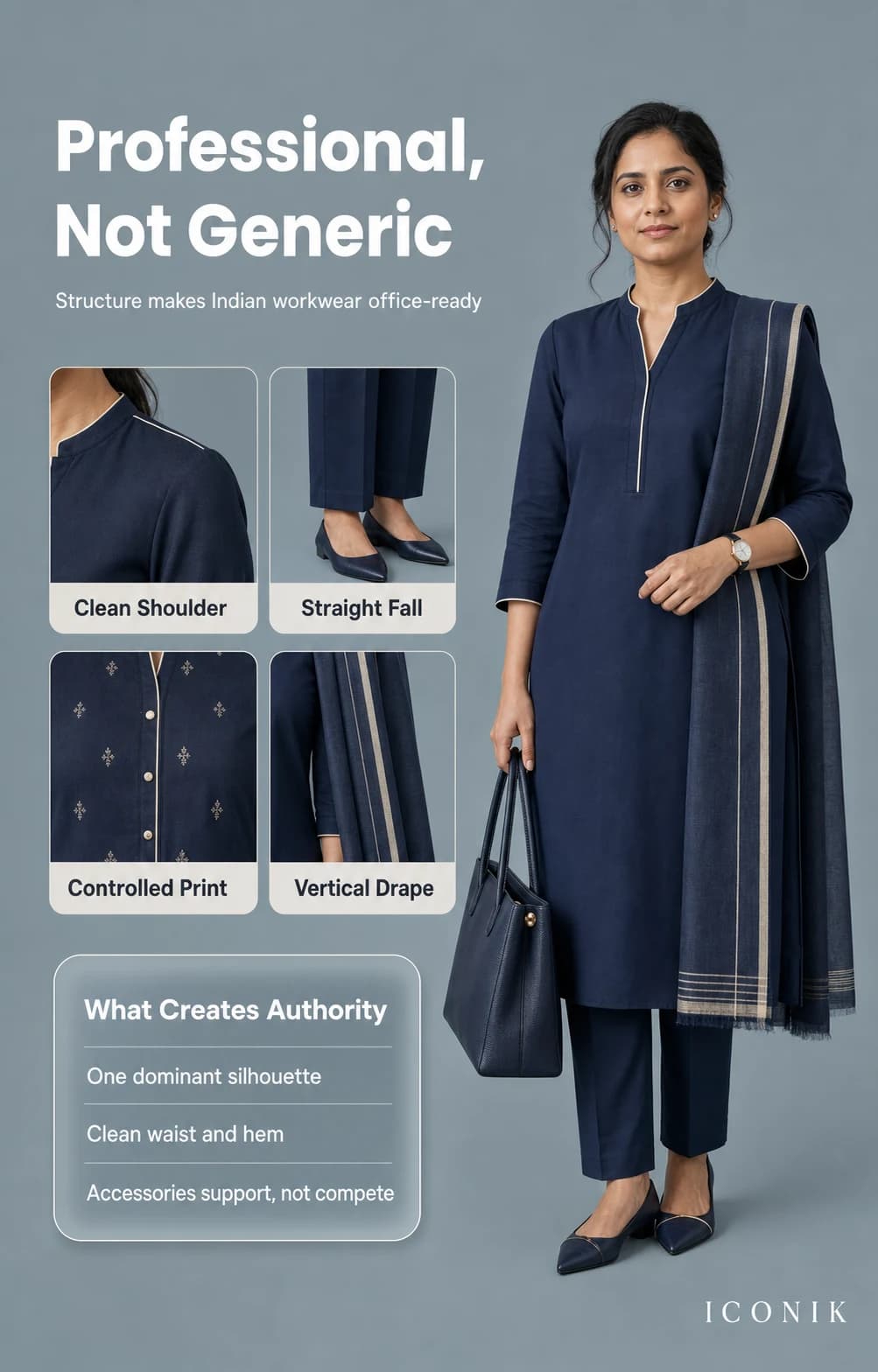
Indian wear can look authoritative at work when the construction, print scale, drape, and accessories support a professional visual hierarchy. The category is not the problem; the execution determines whether the outfit reads as casual, festive, dated, or office-ready.

What to notice

  • Choose a kurta with visible structure instead of a soft boxy shape.
  • Use straight or controlled bottoms rather than defaulting to leggings.
  • Keep prints deliberate and let one element lead the outfit.
  • Use vertical drape and one strong office accessory to create authority.
Read the Reel transcript

Indian wear is not the problem. The problem is wearing it like daily wear and expecting it to look office-ready. Leggings, loud florals, boxy kurtis, casual flats, and soft bags can make even a good kurta look dated, festive, or shapeless. The fix is not to stop wearing Indian wear. The fix is to choose sharper pieces. Structured kurtas. Cleaner bottoms. Controlled prints. Vertical drapes. One strong office accessory. Same category. Different execution. At ICONIK, we study your body geometry, facial architecture, and colour palette to build outfits that work for your real life. Same body. Different science.

See how ICONIK analyses garment structure

From @iconik.style

Visual Hierarchy Makes an Outfit Look Intentional

This Reel uses a celebrity-style evolution as an editorial example of visual hierarchy. The useful lesson is not to copy a person’s wardrobe, but to control which silhouette, tone, neckline, detail, and accessory the eye notices first.

What to notice

  • Let one silhouette establish the outfit’s main direction.
  • Connect two tones so the eye moves through the look without interruption.
  • Use the neckline to frame the face rather than compete with it.
  • Choose one hero detail and make every accessory support it.
Read the Reel transcript

Early Alia dressed for attention. Now she dresses like she already owns it. The shift wasn’t from bold to boring. It was from visual noise to visual hierarchy. One dominant silhouette. Two connected tones. A neckline that frames the face. One hero detail. Accessories that support instead of compete. She didn’t become less experimental. She became more intentional. That’s the difference between wearing a statement and becoming the statement. Get your ICONIK Blueprint through the link in bio. AI model used only to demonstrate styling principles. No real client face was used.

Understand neckline and face framing

Reader questions

Frequently Asked Questions

Can Indian women wear kurtas to corporate offices?

Yes, in most Indian corporate environments. A well-tailored straight-cut kurta in crepe or cotton-linen, worn with straight trousers, reads as professional. The key is silhouette — the kurta should be structured, not boxy. Avoid casual cotton kurtas or heavily embellished ones for daily office wear.

Is a saree appropriate for everyday office wear?

For most Indian offices, a saree for everyday wear suits senior-management level or above, or traditional sectors like law, banking, and academia. For important meetings and formal occasions, sarees are always appropriate and highly professional at any level.

What is the best office outfit formula for an apple body type?

Straight-cut kurta at hip length + cigarette trousers + a structured dupatta draped over one shoulder. This creates a clean vertical line and draws attention away from the midsection. In western wear: structured blazer worn open + wide-leg trousers + fitted V-neck blouse.

How should I dress for a job interview in India?

One level above the company's standard dress code. For a startup: formal kurta-trouser set or a tailored midi dress. For corporate: a formal Anarkali, saree, or blazer-trouser set. Choose your undertone-matched colour — a colour that makes you look energised and authoritative.