Geometric Silhouette Profiling™: ICONIK's Proportion Method
Geometric Silhouette Profiling™ (GSP) is ICONIK's proprietary styling framework for comparing shoulder, bust, waist and hip relationships, torso and limb proportion, and current garment fit. It turns those observations into options to test—not a diagnosis or a rule that the body must be corrected.
Updated 24 July 2026 · Reviewed by Jasmine Rana, Co-Founder and Head Stylist
Why Was Geometric Silhouette Profiling™ Developed?
Many body-type quizzes use only a few self-reported questions and illustrate their advice with jeans, dresses and blazers. They rarely explain how the same proportion principle changes kurta length, saree drape, salwar shape or dupatta placement.
GSP was developed to translate proportion observations into Indian, western and fusion wardrobes while keeping the client's comfort, taste and lifestyle in the decision.
How Does Geometric Silhouette Profiling™ Work?
GSP is a five-stage analysis process:
- Frame mapping: Proportional measurement of shoulder span, bust circumference relative to shoulder, waist circumference, hip span, torso length, and limb length.
- Soft tissue assessment: Identifying where volume is distributed — midsection, hip and thigh zone, bust, upper arm.
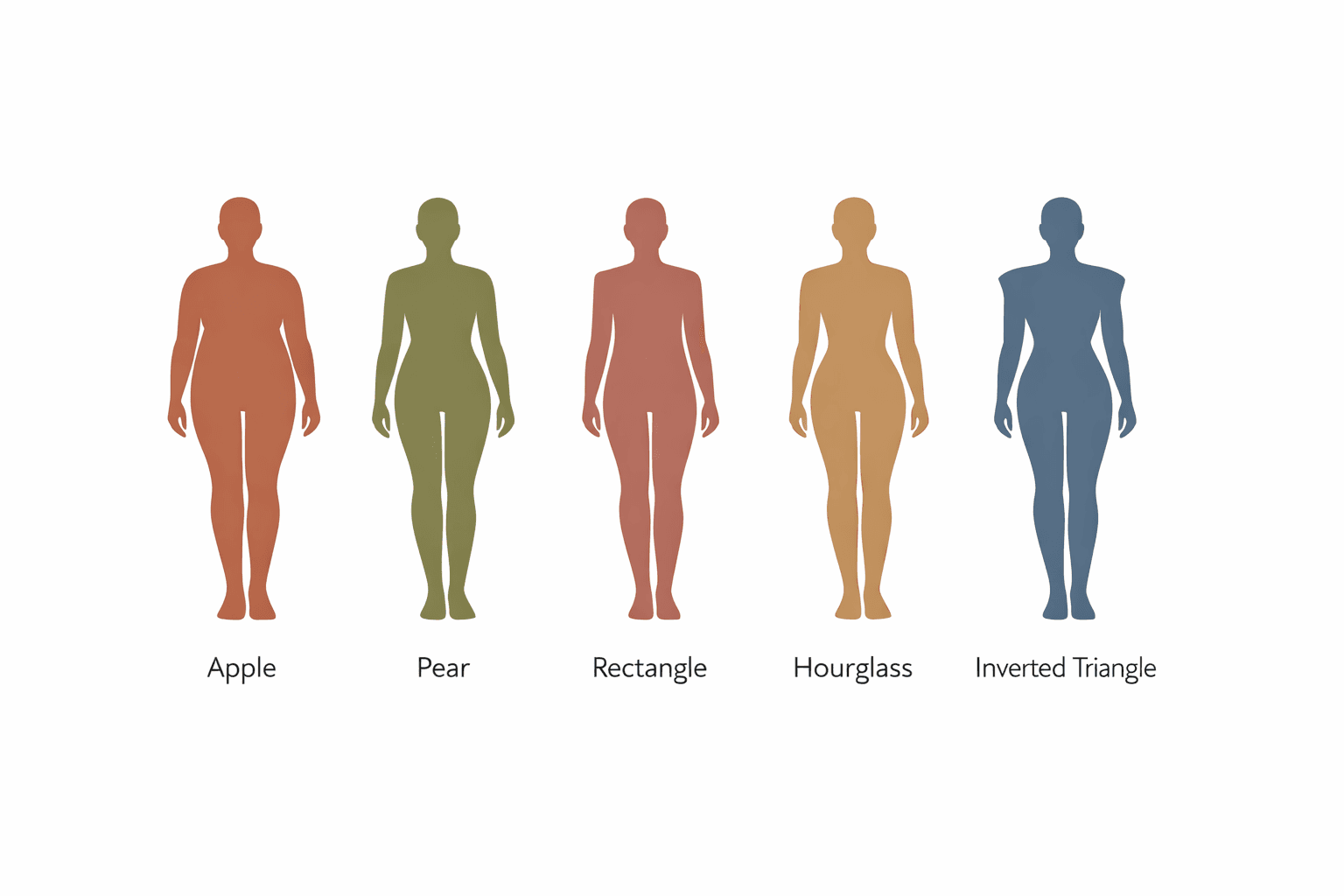
- Silhouette classification: Mapping the measurements to one of five primary archetypes: Apple, Pear, Rectangle, Hourglass, or Inverted Triangle.
- Hybrid profiling: Many women fall between archetypes. GSP identifies the primary and secondary type and weights the recommendations accordingly. An apple-pear hybrid gets a different prescription than a pure apple.
- Garment options: Cuts, silhouettes and lengths selected for the observed proportions, with Indian ethnic-wear categories included.
What Are the Five Silhouette Archetypes in GSP™?
GSP identifies five primary archetypes, plus hybrid profiles between them:
- Apple: Midsection-dominant. Waist as wide as or wider than bust and hips. Slimmer legs. Styling goal: elongate torso, create vertical line.
- Pear: Hip-dominant. Hips notably wider than shoulders. Styling goal: visually broaden upper body to balance lower body.
- Rectangle: Column silhouette. Shoulders, waist, and hips roughly equal. Styling goal: create waist definition and add visual curve.
- Hourglass: Bust and hips roughly equal, with a significantly narrower waist. Styling goal: emphasise and celebrate the waist.
- Inverted Triangle: Shoulder-dominant. Shoulders notably wider than hips. Styling goal: add visual volume at the lower body.
How Is GSP™ Different from a Standard Body Shape Quiz?
| Feature | Standard Quiz | GSP™ |
|---|---|---|
| Input method | Self-reported | Stylist-assessed |
| Categories | 3–4 categories | 5 archetypes + hybrids |
| Soft tissue | Not assessed | Mapped specifically |
| Indian garments | Not covered | Full prescription |
| Output | Generic category tips | Garment-level prescription |
| Lifestyle context | Western default | Indian lifestyle-specific |
How Does GSP™ Integrate with Chromatic Harmony Mapping™ and Facial Architecture Analysis™?
GSP is the structural first pillar of the Iconik Style Blueprint. It defines the body geometry and garment prescription. Chromatic Harmony Mapping™ then layers the colour analysis — identifying which shades within a garment category are most harmonious with the client's undertone. Facial Architecture Analysis™ adds the face-specific layer — necklines, earring shapes, and hairstyle directions.
Together, the three methodologies produce a three-dimensional styling prescription: what to wear (GSP™), in which colours (CHM™), with which face-framing details (FAA™). Each layer adds specificity that a single-variable approach cannot achieve.
Frequently Asked Questions
Who developed Geometric Silhouette Profiling™?
Geometric Silhouette Profiling™ was developed by the ICONIK methodology team and is reviewed by Jasmine Rana, Co-Founder and Head Stylist. It applies proportion concepts to Indian, western and fusion garment categories.
Is Geometric Silhouette Profiling™ a scientific or medical assessment?
No. GSP is a proprietary styling framework, not a clinical, biomechanical or scientifically validated diagnostic tool. It uses measurements and visual proportion to make garment recommendations, which should still be adapted to comfort, mobility, taste and the way a specific garment fits.
How is GSP™ applied in an Iconik Blueprint?
During your Blueprint intake, a stylist uses measurements, photos and consultation context to identify useful proportion patterns. The output is a set of garment-level options—cuts, lengths, silhouettes and Indian-wear categories—to test against your preferences and real fit.
Can I do Geometric Silhouette Profiling™ myself?
Yes. Careful measurement and the ICONIK body-type guide can provide a useful starting point. A Blueprint adds stylist review, hybrid proportion notes and Indian-garment application, but a self-assessment can still help you test one garment variable at a time.
Related Guides
Want GSP™ applied to your body within 5 working days after the consultation?
Your personalised Iconik Style Blueprint uses all three methodologies — GSP™, CHM™, and FAA™ — to produce a complete, precise styling prescription.
Get My Style Blueprint — ₹2,699Cite this article:
Rana, Jasmine. "Geometric Silhouette Profiling™: ICONIK's Proportion Method." ICONIK LLP. Updated 24 July 2026. https://www.iconik.pro/methodology/geometric-silhouette-profiling