Scope and limits
What Facial Architecture Analysis Is—and What It Is Not
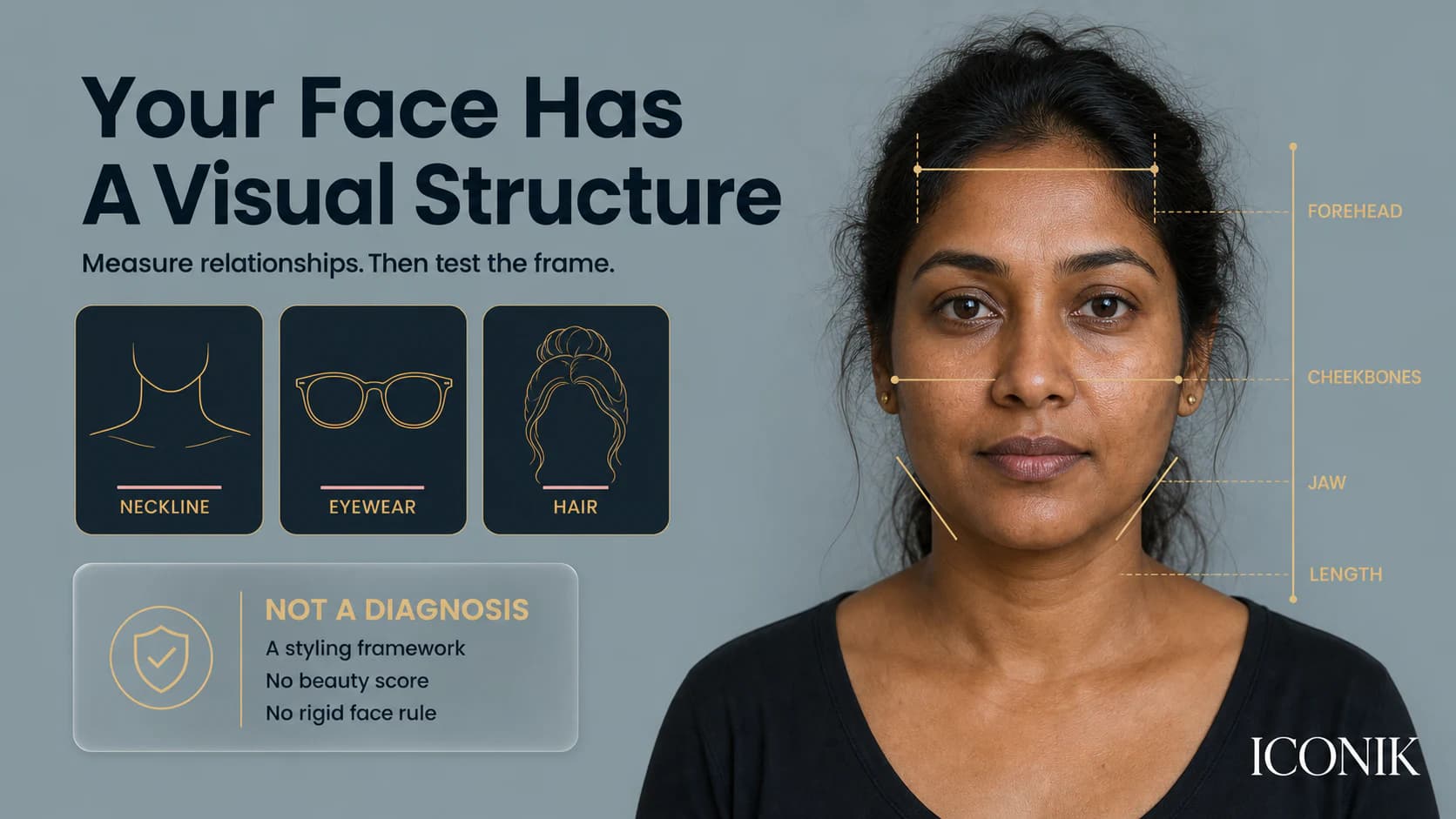
Facial Architecture Analysis is ICONIK's name for a face-framing styling process. It describes the visible relationship between the forehead, cheekbones, jaw, chin, and overall face length. Those relationships are then considered beside the shapes closest to the face: neckline, collar, glasses, earrings, hair outline, and sometimes a bindi, dupatta, or saree pallu.
It is not a claim that facial geometry determines beauty, personality, health, age, or one objectively correct hairstyle. It also does not replace an optician for eyewear fit or a hairstylist who can assess texture, density, growth pattern, and maintenance.
Stage 01 · Observation
How to Observe Facial Proportions Without Distorting Them
Use a front-facing photograph taken from farther away at approximately eye level. Move the hair away from the outer face, keep the expression relaxed, and use even daylight. Avoid a close phone selfie: wide-angle perspective can enlarge the centre of the face and change the apparent jaw and forehead relationship.
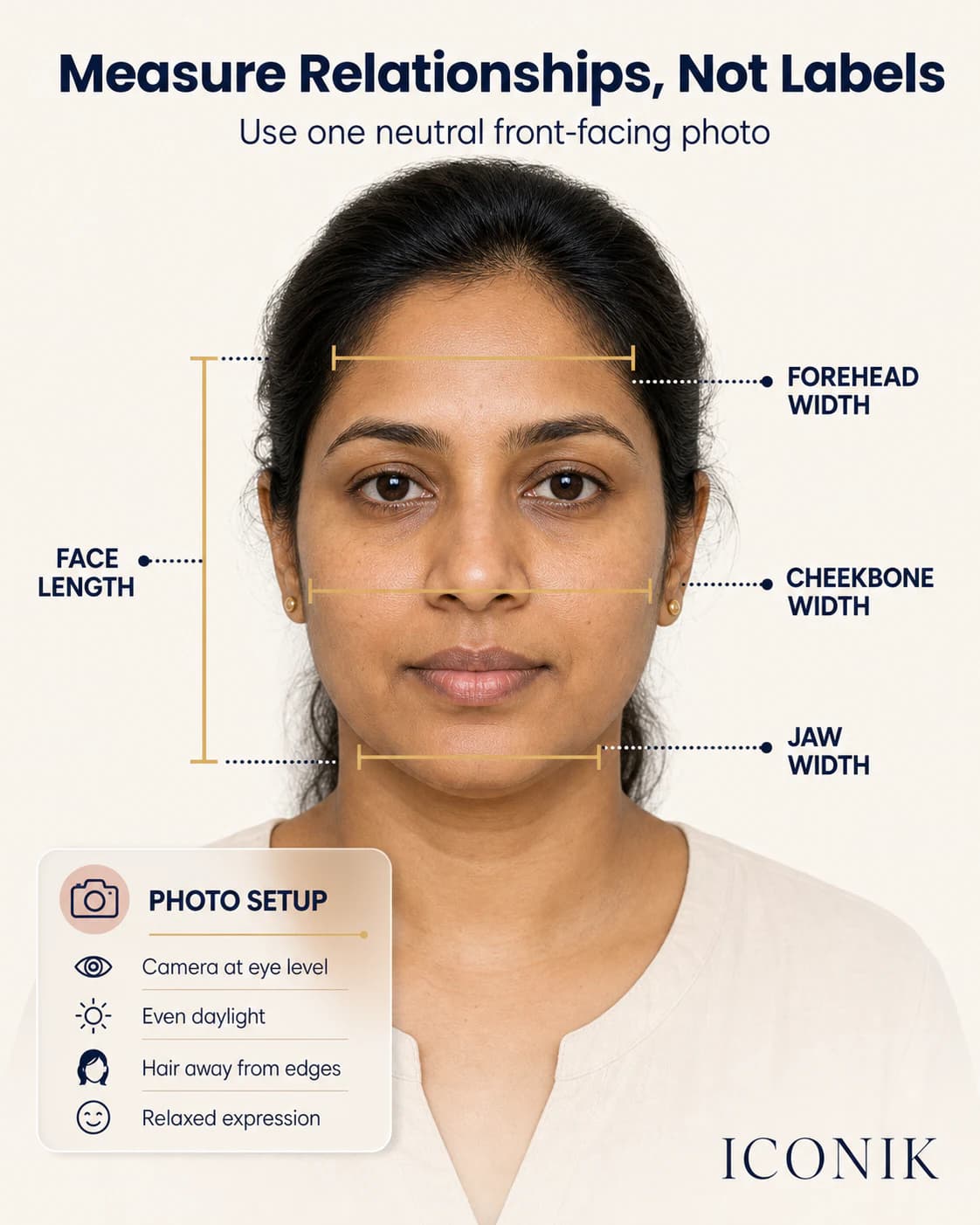
- Face length: compare the hairline-to-chin distance with the widest horizontal area.
- Forehead: observe its visible width and whether it narrows or remains straight toward the temples.
- Cheekbones: note whether they form the widest point and how strongly the face tapers above and below.
- Jaw: observe width, corner definition, curve, and the direction toward the chin.
Repeat the observation in two images. Hairline visibility, expression, lighting, and camera distance can change a first impression. The repeated relationship is more useful than forcing a label from one photo.
Stage 02 · Description
Use Face-Shape Families as Shortcuts, Not Final Answers
Oval, round, square, rectangle, heart, diamond, and oblong are common descriptive families. They help name a dominant relationship, but they are not fixed biological types. “Round-square,” “oval-heart,” or another hybrid description may be more accurate than choosing one rigid category.
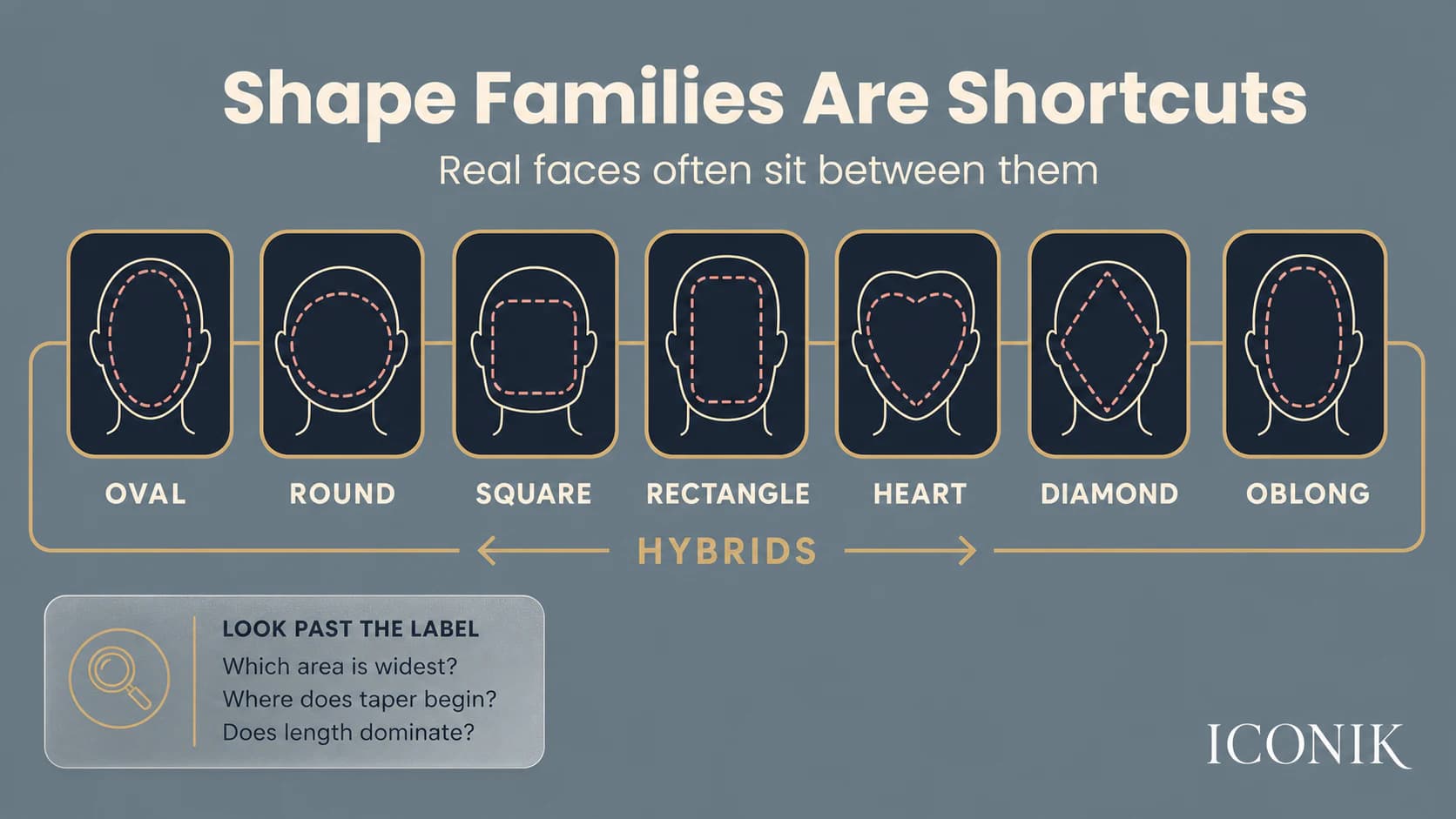
Length dominant
Longer face with varying amounts of width through forehead, cheeks, and jaw.
Width dominant
Length and width appear closer, with either curved or angular outer lines.
Upper width dominant
Forehead or temple area leads, then the face tapers toward the chin.
Cheekbone dominant
The mid-face is widest, with visible taper toward forehead and jaw.
Jaw dominant
Lower-face width or angle carries more visual weight than the upper face.
Balanced distribution
No single zone strongly dominates; detail and styling intent matter more.
Stage 03 · Garment framing
Test Necklines as Directional Shapes Around the Face
A neckline affects more than face shape. It also interacts with neck length, shoulder width, bust, garment structure, jewellery, modesty, and occasion. That is why a list saying “round face equals V-neck” is incomplete.
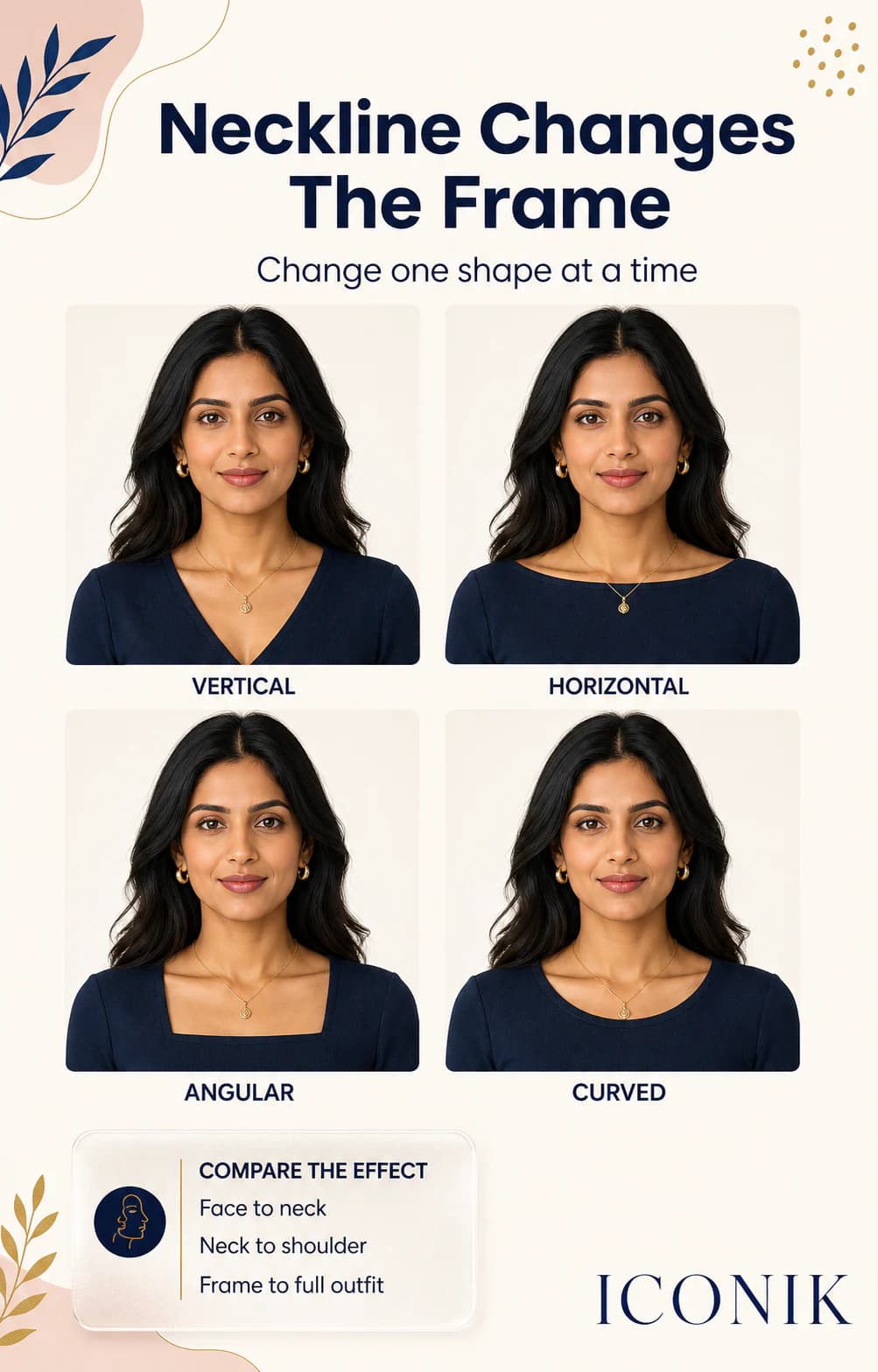
- V and open notches: add a downward direction and reveal more vertical space through the neck and chest.
- Boat and wide square necks: create width across the collarbone and can connect the face more strongly to the shoulder line.
- Soft round and sweetheart shapes: repeat curvature and can soften a very angular garment or jaw relationship.
- High collars and closed necks: reduce visible neck space and place more emphasis near the jaw; fabric stiffness changes the result.
The four-photo neckline test
Hold four plain fabrics or garments at the same height: V, open round, square, and wide horizontal. Keep hair, earrings, expression, and camera unchanged. Compare whether your priority—length, width, softness, authority, or modest coverage—is being created without causing another part of the outfit to feel disconnected.
Stage 04 · Accessory geometry
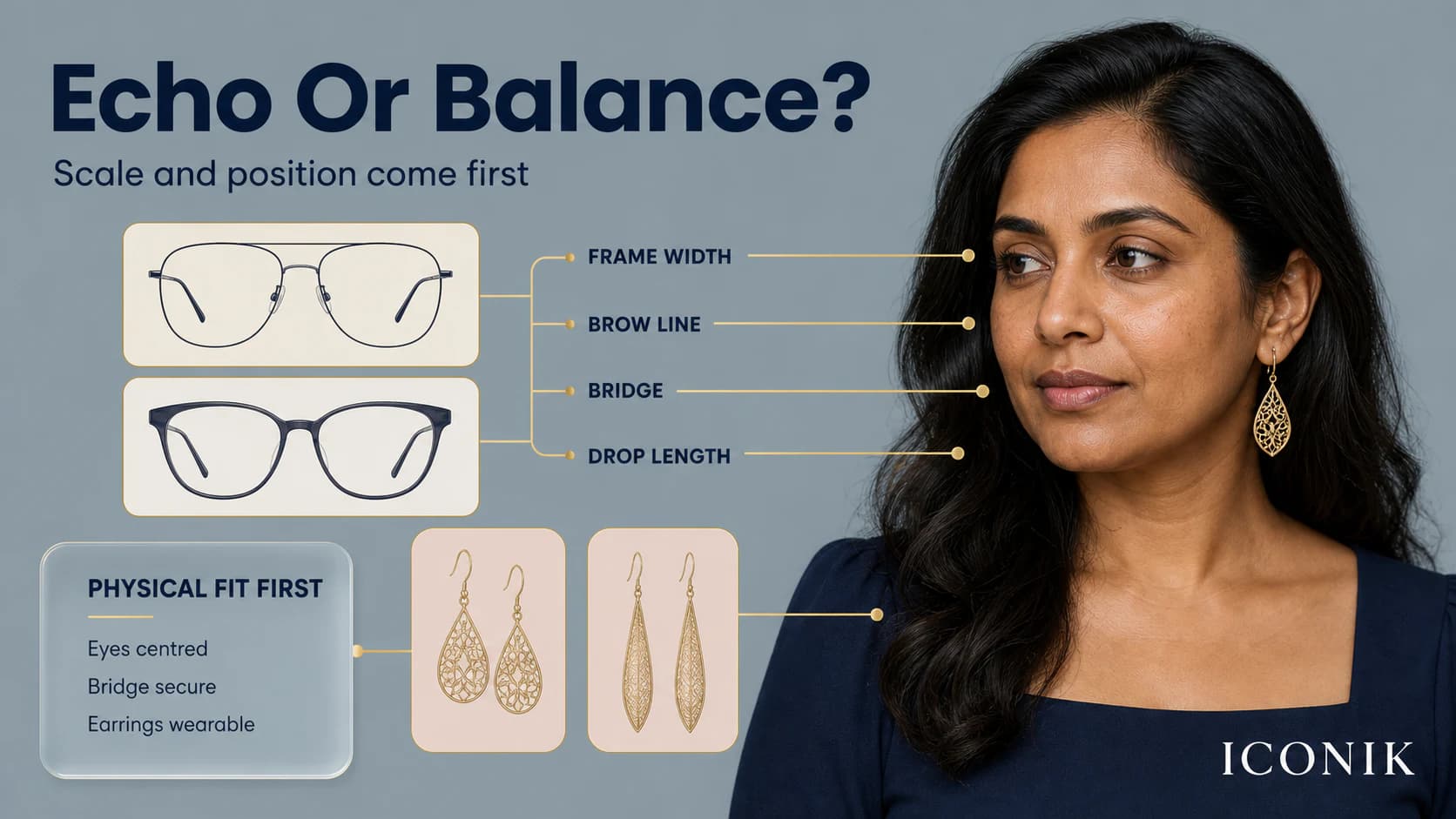
Choose Eyewear and Earrings by Scale, Position, and Direction
“Opposite your face shape” is too simple for glasses. A frame must align with the brow, sit comfortably on the bridge, fit the temple width, keep the eyes well positioned in the lenses, and work with the prescription. Styling comes after physical fit.
Stage 05 · Hair architecture
Place Hair Volume Where It Supports the Intended Frame
Hair changes the visible outline of the head and face more than most accessories. Crown volume adds vertical emphasis; cheek or jaw-level volume adds width; a centre part creates symmetry; an off-centre part introduces direction. Face-framing layers can reveal or partially interrupt the cheekbone and jaw.
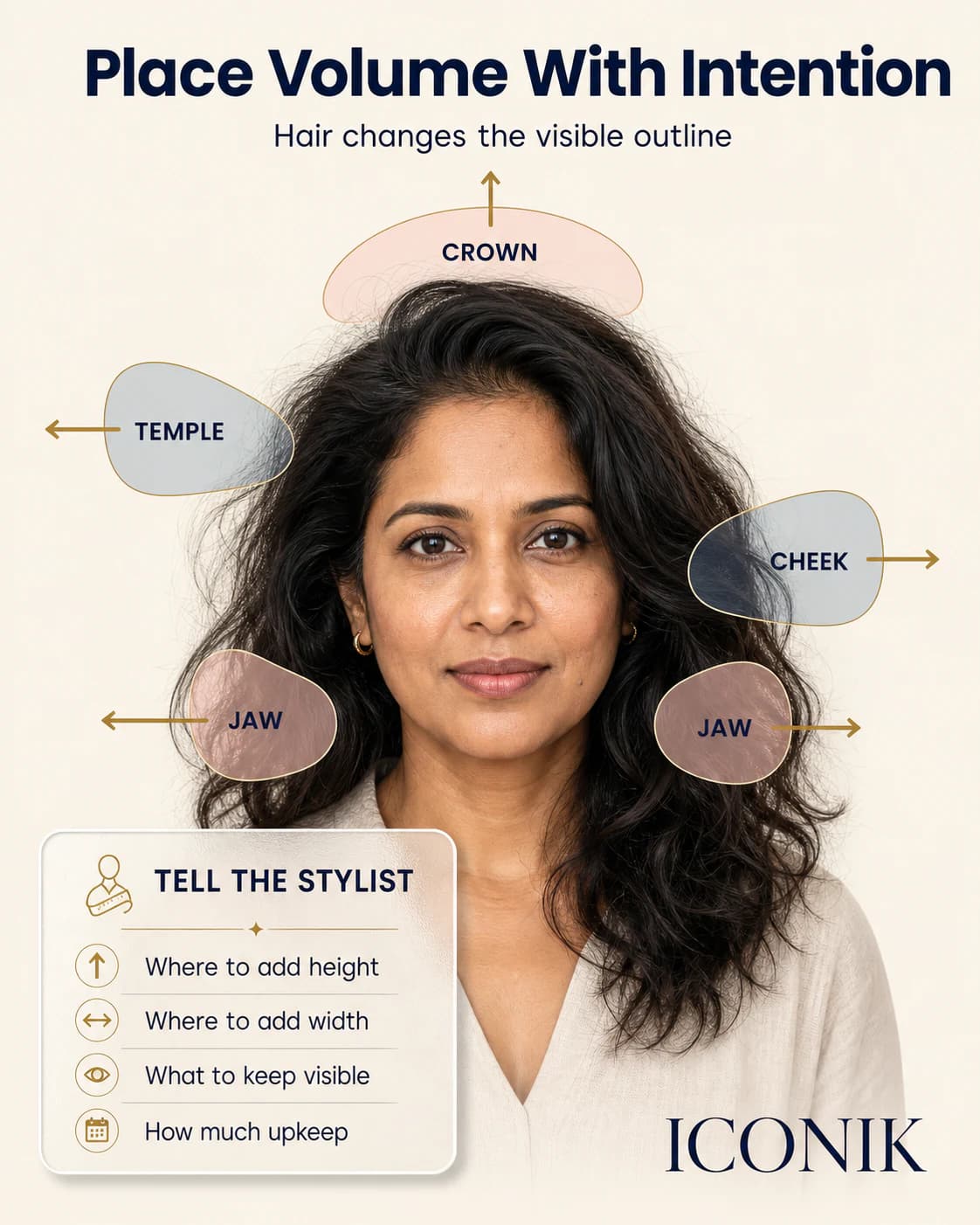
ICONIK's useful role is to describe the visual objective: more height, more side width, a cleaner jaw reveal, softer forehead framing, or controlled asymmetry. A hairstylist should then translate that objective into a cut or style that suits your curl pattern, density, hairline, lifestyle, and willingness to style it.
The complete system
Facial Framing Must Agree With the Rest of the Outfit
A neckline can lengthen the face but still be wrong for the bust, shoulder, dress code, or modesty preference. A perfect colour can still lose impact if the glasses, earrings, neckline, print, and lip colour all compete near the face. The final decision needs hierarchy.
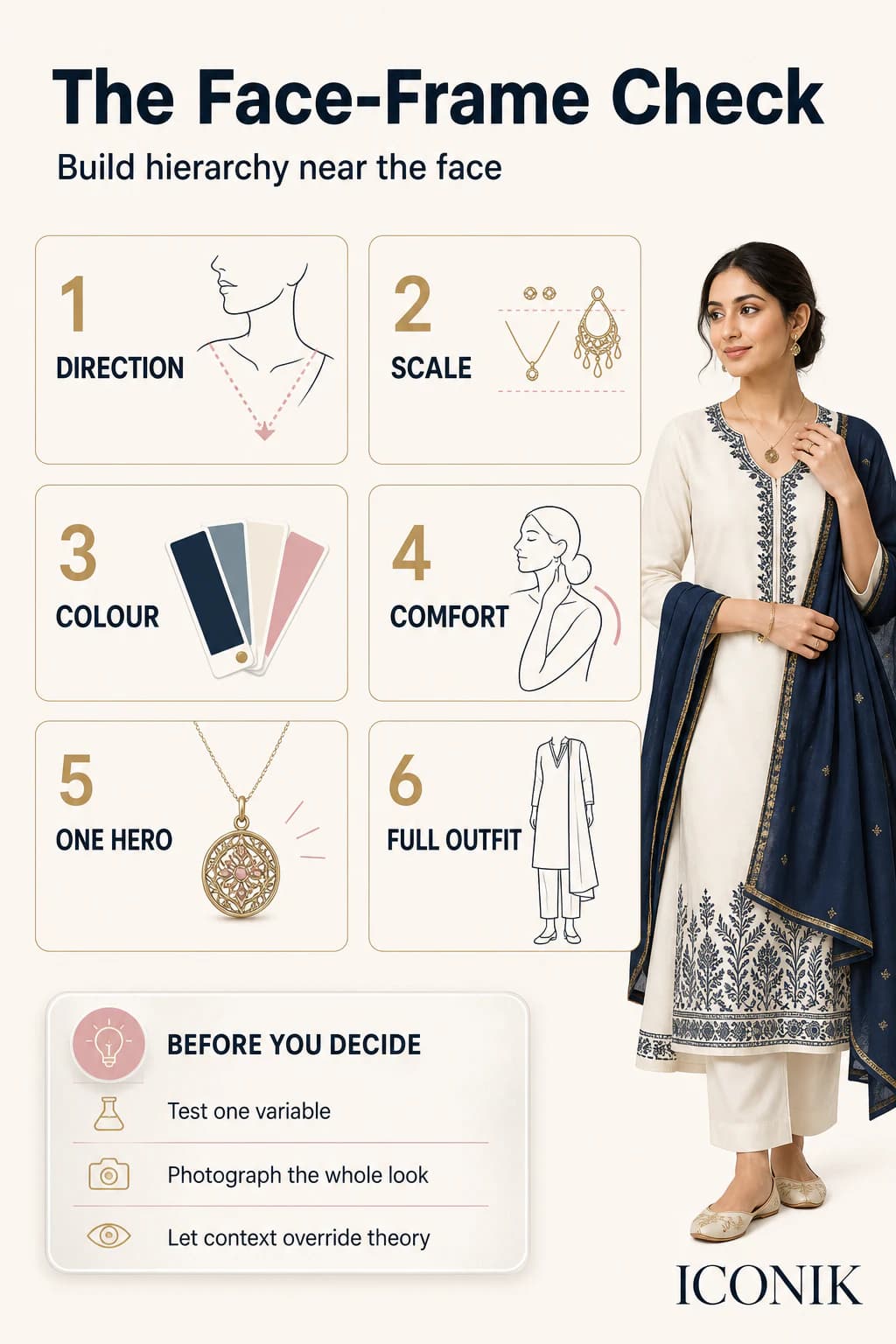
- Choose the dominant direction: vertical, horizontal, curved, angular, or asymmetric.
- Choose one hero: neckline, glasses, earrings, hair, or colour—not all five.
- Check scale: relate accessory and print size to face, hair, shoulder, and garment scale.
- Check colour: make metal, frame, hair, neckline, and lip colour support one palette.
- Check comfort and context: prescription, earring weight, maintenance, modesty, and dress code override theory.
- Photograph the whole outfit: a face crop cannot reveal whether the frame connects to the body.
Cite this guide: Rana, Jasmine. “Facial Architecture Analysis: ICONIK's Face-Framing Styling Method.” ICONIK LLP. Updated 24 July 2026.