Chromatic Harmony Mapping™: ICONIK's Colour Method
Chromatic Harmony Mapping™ (CHM) is ICONIK's proprietary styling framework for comparing undertone, skin depth, contrast and wardrobe context. It produces a focused palette for the client's real garments; it is not a medical test and does not claim that one set of colours is objectively compulsory.
Updated 24 July 2026 · Reviewed by Jasmine Rana, Co-Founder and Head Stylist
Why ICONIK Adapted Conventional Colour Analysis
Seasonal colour analysis organises people into palettes such as Spring, Summer, Autumn and Winter. Many publicly available examples and drape sets show a limited range of skin depths and focus on Western garment categories, which can make the method difficult to translate to Indian wardrobes.
Dark hair and eyes should not automatically result in an "Autumn" label. Controlled draping can reveal cool, neutral, olive, bright or muted characteristics across any skin depth.
CHM keeps the useful practice of side-by-side colour comparison, then adds Indian skin-depth references, jewellery, ethnic wear and the client's actual wardrobe needs.
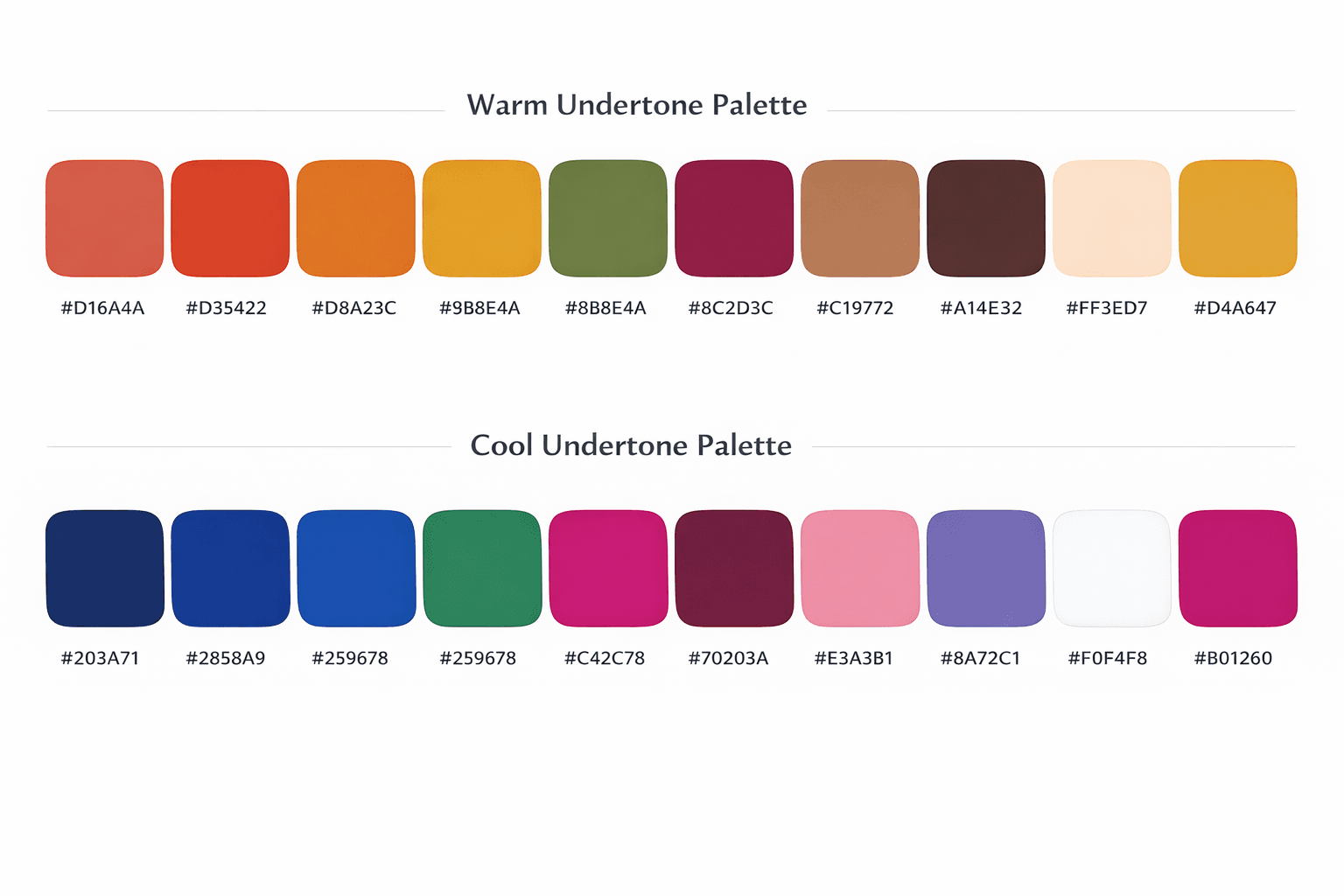
How Does Chromatic Harmony Mapping™ Work?
CHM is a five-stage protocol:
- Controlled colour comparison: Comparing warm, cool and neutral drapes near the face in indirect daylight. Vein and jewellery observations may be noted, but they are not treated as decisive on their own.
- Melanin depth assessment: Identifying the depth of pigmentation — fair, medium, deep, or very deep — which determines how chromatic vs muted the palette recommendations should be.
- Palette construction: Combining temperature, depth and clarity observations to select 10 useful reference colours.
- Contrast level assessment: Determining whether the client has high-contrast colouring (e.g., very dark hair, fair skin) or low-contrast colouring — which affects whether high-contrast or tone-on-tone colour combinations work best.
- Application guide: Translating the palette into practical guidance for Indian garment categories — which colours to use in sarees, kurtas, blouses, salwars, and dupattas.
What Does CHM™ Produce?
The CHM output delivered in your Style Blueprint includes:
- Your identified undertone (warm / cool / neutral)
- 10 exact colours in your harmony palette, with colour names and references
- Your 3 best neutrals (for everyday wear foundations)
- Your 3 strongest accent colours (for statement pieces)
- Colours to avoid and why they clash with your undertone
- Guidance on applying the palette to Indian ethnic garment categories
- Your best white (stark white vs ivory vs warm cream)
- Your best metal for jewellery (gold vs silver vs both)
How Is CHM™ Different from Seasonal Colour Analysis?
| Feature | Seasonal Analysis | CHM™ |
|---|---|---|
| Framework | 4 seasons | Undertone + depth + contrast |
| Indian context | Depends on practitioner and drape set | Indian skin-depth and wardrobe examples |
| Output | Season category + general palette | 10 exact colours + application guide |
| Indian garments | Depends on practitioner | Kurta, saree and salwar application included |
| Skin depth | Varies by system and practitioner | Explicitly considered |
Frequently Asked Questions
Who developed Chromatic Harmony Mapping™?
Chromatic Harmony Mapping™ was developed by the ICONIK methodology team and is reviewed by Jasmine Rana, Co-Founder and Head Stylist. It adapts colour-comparison principles to Indian skin-depth examples, olive undertones and Indian wardrobe categories.
What undertones does CHM™ identify?
CHM identifies three primary undertones: warm (yellow/golden base), cool (pink/blue/red base), and neutral (a balance of both). Within each, it further calibrates for melanin depth and contrast level — producing a palette that is precise to the individual, not just the undertone category.
Is Chromatic Harmony Mapping™ the same as seasonal colour analysis?
No. CHM does not assign a Spring, Summer, Autumn or Winter season. It uses undertone, skin depth, contrast and wardrobe context to produce a focused palette. Seasonal analysis can still be useful when it is applied by an experienced practitioner with representative drapes.
How is CHM™ delivered in an Iconik Blueprint?
Your Blueprint includes your identified undertone, your 10-colour harmony palette with exact colour names and references, your 3 best neutrals, your 3 strongest accent colours, colours to avoid, and a guide to applying those colours to your most common garment categories including Indian ethnic wear.
Related Guides
Want CHM™ applied to your skin within 5 working days after the consultation?
Your Iconik Style Blueprint includes your full Chromatic Harmony Mapping™ colour palette — 10 exact colours, application guide, and Indian garment colour prescription.
Get My Style Blueprint — ₹2,699Cite this article:
Rana, Jasmine. "Chromatic Harmony Mapping™: ICONIK's Colour Method." ICONIK LLP. Updated 24 July 2026. https://www.iconik.pro/methodology/chromatic-harmony-mapping