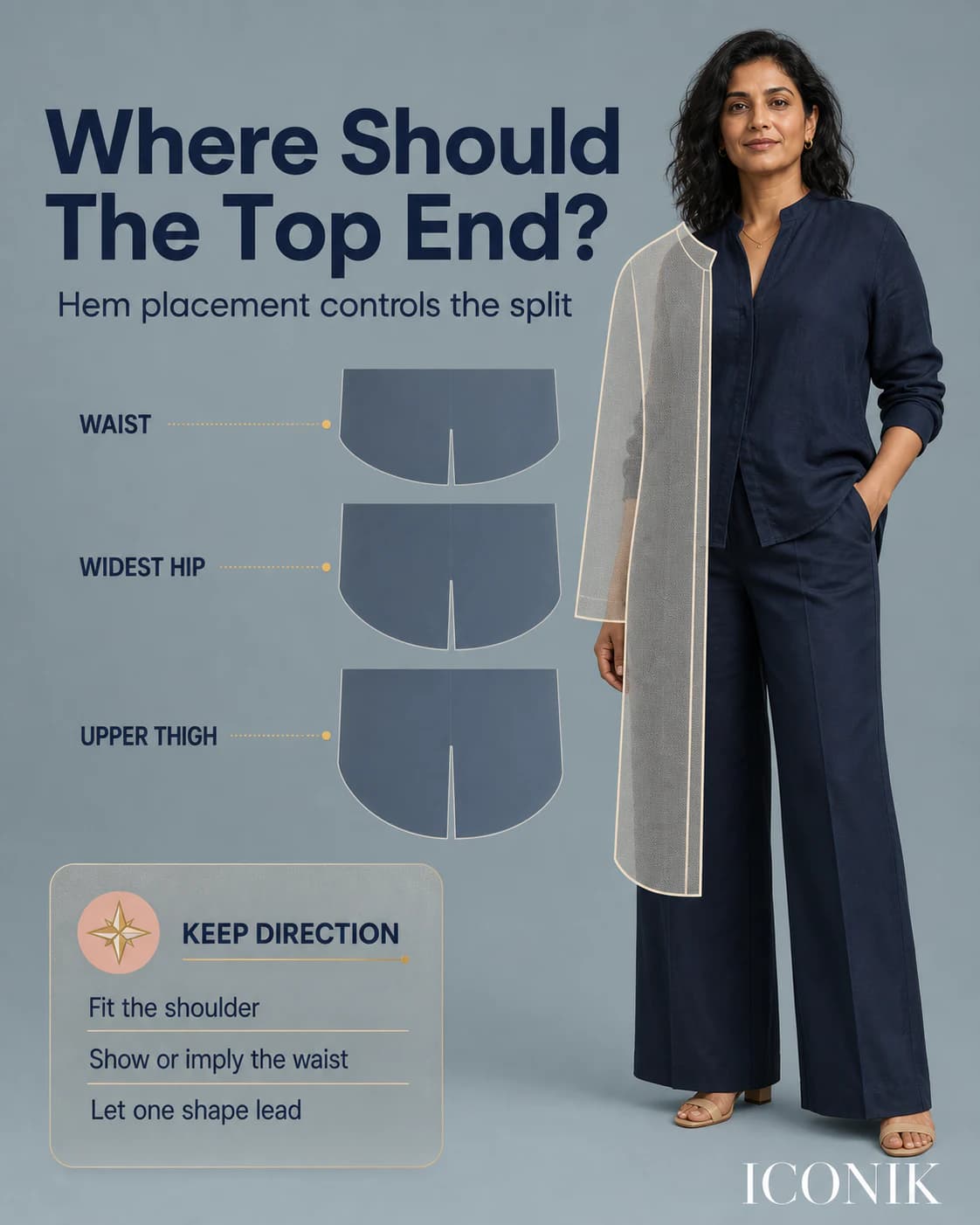
Measure kurti length by body landmark
Product listings usually measure from the high shoulder point to the hem. That number is useful for comparing two products, but it does not predict where the kurti will land on every person.
When trying a kurti, record the actual landmark:
- above the hip;
- at the fullest hip;
- upper thigh;
- above, at or below the knee;
- mid-calf; or
- ankle.
Bust projection, shoulder slope, torso length and size can all make the front and back hem sit differently. Check both sides, not only the front mirror view.
Five useful kurti-length families
Above or around the upper hip
Short or tunic
Try with: Jeans, straight trousers, wide trousers or skirts depending on volume
Check: A boxy shape can lose direction if both top and bottom are equally wide
Around the hip or upper thigh
Hip length
Try with: Straight trousers, cigarette pants, jeans and controlled palazzos
Check: Move the hem if it cuts exactly across a point you do not want emphasised
Above, at or just below the knee
Knee length
Try with: Straight trousers, churidars and some palazzos
Check: Check side-slit height and whether the bottom width competes with the kurti
Between knee and ankle
Calf length
Try with: Straight, narrow or wide bottoms when the proportions are deliberate
Check: Judge where the hem meets the calf and whether fabric gathers around the leg
Near the ankle or shoe
Ankle or floor length
Try with: Narrow hidden bottoms, full-length layers or occasion silhouettes
Check: Check walking clearance, pooling, flare volume and whether footwear finishes the line
Match length to the proportion you want to create
For a longer leg impression
Test a shorter kurti with a higher-looking rise, or use a longer kurti and bottom in a related colour so the eye follows one route. These are different solutions to the same goal.
For more visible waist direction
Use a shaped side seam, wrap, panel, belt or controlled tuck. Length alone cannot create a waist if the garment remains equally wide from shoulder to hem.
For less emphasis at the hip or tummy
Move the hem away from the fullest point, reduce cling, and make sure the fabric falls from a stable shoulder or yoke. Longer is not automatically better; a long garment can still pull or bunch.
For stronger lower-body presence
Use a shorter or cleaner top line with a wider, brighter or more textured bottom. This can support an inverted-triangle proportion or simply make the trousers the outfit's hero.
Pair kurti length with bottom width
- Short + wide: can look directional when the kurti fits at the shoulder and the trouser falls cleanly.
- Hip length + straight: an easy workwear formula when the hem and waistband do not compete.
- Knee length + narrow: creates a clear kurti-led line; check slit height and mobility.
- Knee or calf + wide: needs intentional volume and enough height in the side slit or shoe line to avoid visual heaviness.
- Ankle length: check whether the visible bottom, if any, supports rather than interrupts the final line.
Add the dupatta last. A long one-sided drape reinforces vertical direction; a wide shoulder drape adds upper-body presence. Neither is universally more flattering.
The kurti fitting-room checklist
- Does the shoulder seam sit correctly?
- Is the front hem being lifted by bust or tummy fit?
- Does the hem land at an intentional body landmark?
- Can you sit, walk and raise your arms without the kurti riding up?
- Does the side slit begin at a comfortable and useful point?
- Does the bottom width support the kurti rather than compete with it?
- Does the footwear finish the line without avoidable pooling?
Photograph the complete outfit from a consistent distance before altering the length. Compare one hem change at a time. Continue with the body-type styling hub for more proportion guidance.