Start here
Looking Taller Is About Ratios, Not Rules for “Petite” Bodies
Two women can be the same height and need different clothing adjustments. One may have relatively longer legs and a shorter torso; the other may have a longer torso and a lower visual waist. Shoulder width, bust, hip width, and where garments naturally break also change what the eye notices.
Before buying anything, take one straight, full-length photograph in a fitted top and simple trousers. Mark the shoulder, natural waist, crotch level, knee, and floor. You are not measuring whether your body is “correct.” You are locating the divisions that clothing can repeat, raise, lower, or blur.
Mechanism 01
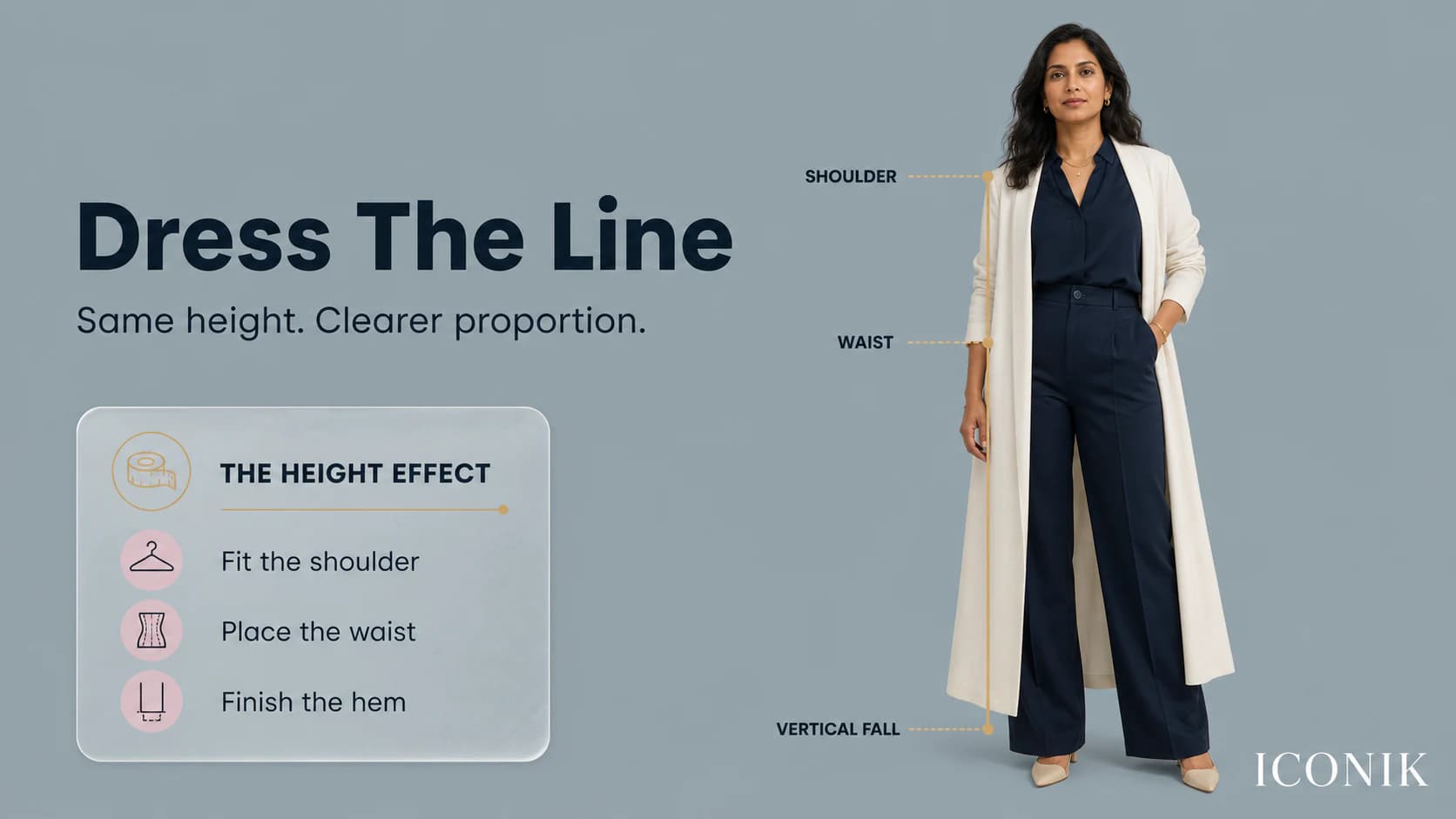
Build Vertical Continuity Without Dressing Head-to-Toe in One Colour
Monochrome works because it removes colour breaks, but it is not the only solution. Vertical continuity can come from a central opening, a trouser crease, a long lapel, a matching blouse and saree, a narrow print repeat, or colours that are close enough in value that the eye moves through them.
Start with a column: top and bottom in the same or neighbouring colours. Then add one layer that remains open, one accessory near the face, or one contrast shoe. If you want colour blocking, place the strongest break at the visual waist you intend to create instead of letting an untucked hem choose it accidentally.
- Strong continuity: navy top, navy straight trouser, open ivory jacket.
- Soft continuity: cocoa kurta, mushroom trouser, bronze footwear.
- Deliberate contrast: cropped shirt ending at a true high-rise waistband.
- Unplanned interruption: long contrast top ending low over a low-rise bottom.
Mechanism 02
Use Waist Placement to Change Where the Legs Visually Begin
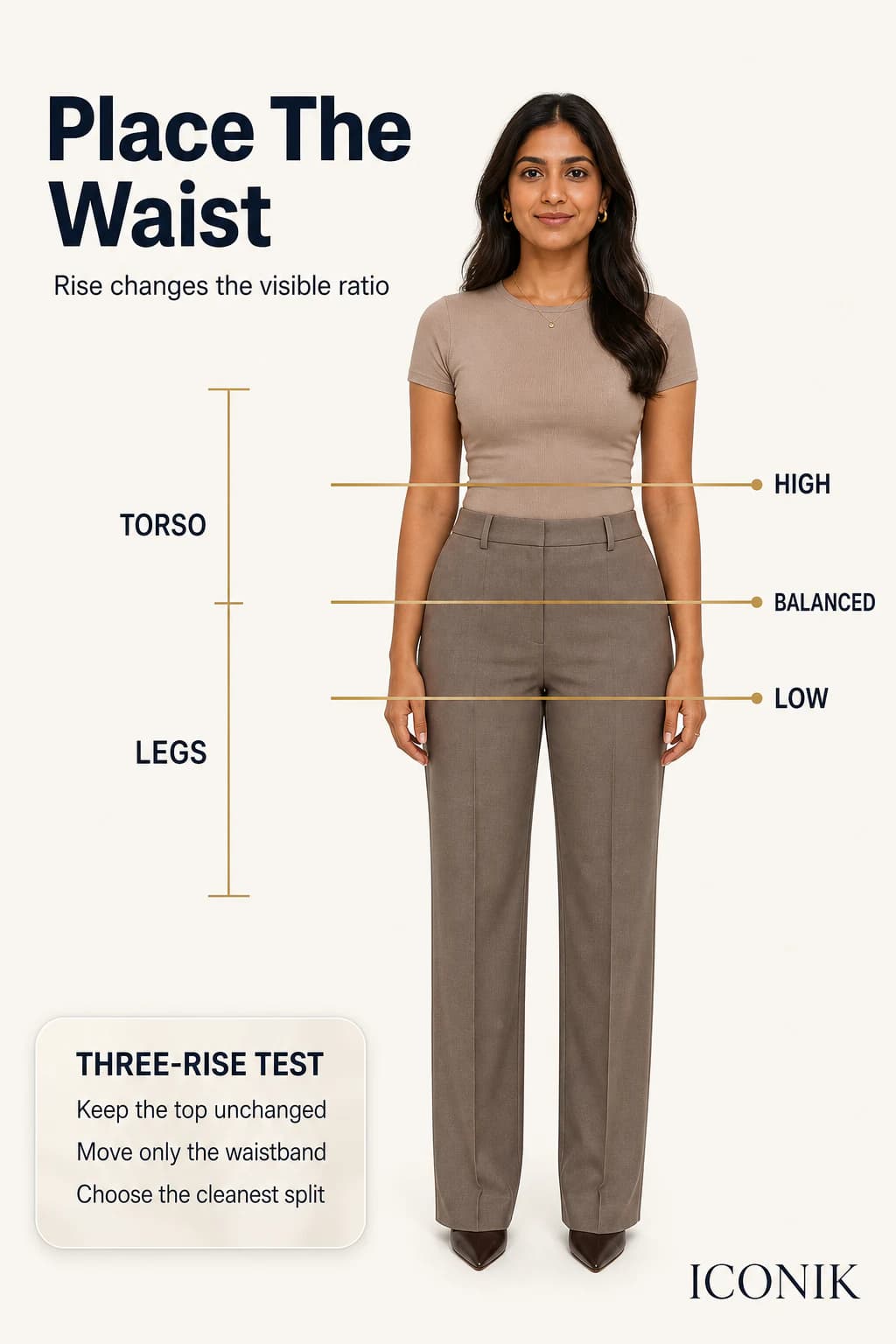
Rise is powerful because the waistband becomes a map line. A higher rise can lengthen the visible leg, but only if the waistband sits smoothly and the top allows it to be read. A bulky tuck can add width and shorten the torso so abruptly that the outfit loses balance.
If you have a short torso, do not automatically choose the highest rise available. Test a clean mid-high rise, partial tuck, or tonal top so the waist is present without climbing into the ribcage. If you have a longer torso, a clearer high rise and shorter top can create a more useful leg-to-torso ratio.
Run the three-rise test
- Photograph the same top with low, mid-high, and high-rise bottoms.
- Keep the camera, posture, footwear, and hem length unchanged.
- Compare the leg-to-torso ratio and whether the waistband adds bunching.
- Choose the cleanest proportion—not simply the highest waistband.
Mechanism 03
Choose Jeans by Vertical Fall and Upper-to-Lower Balance
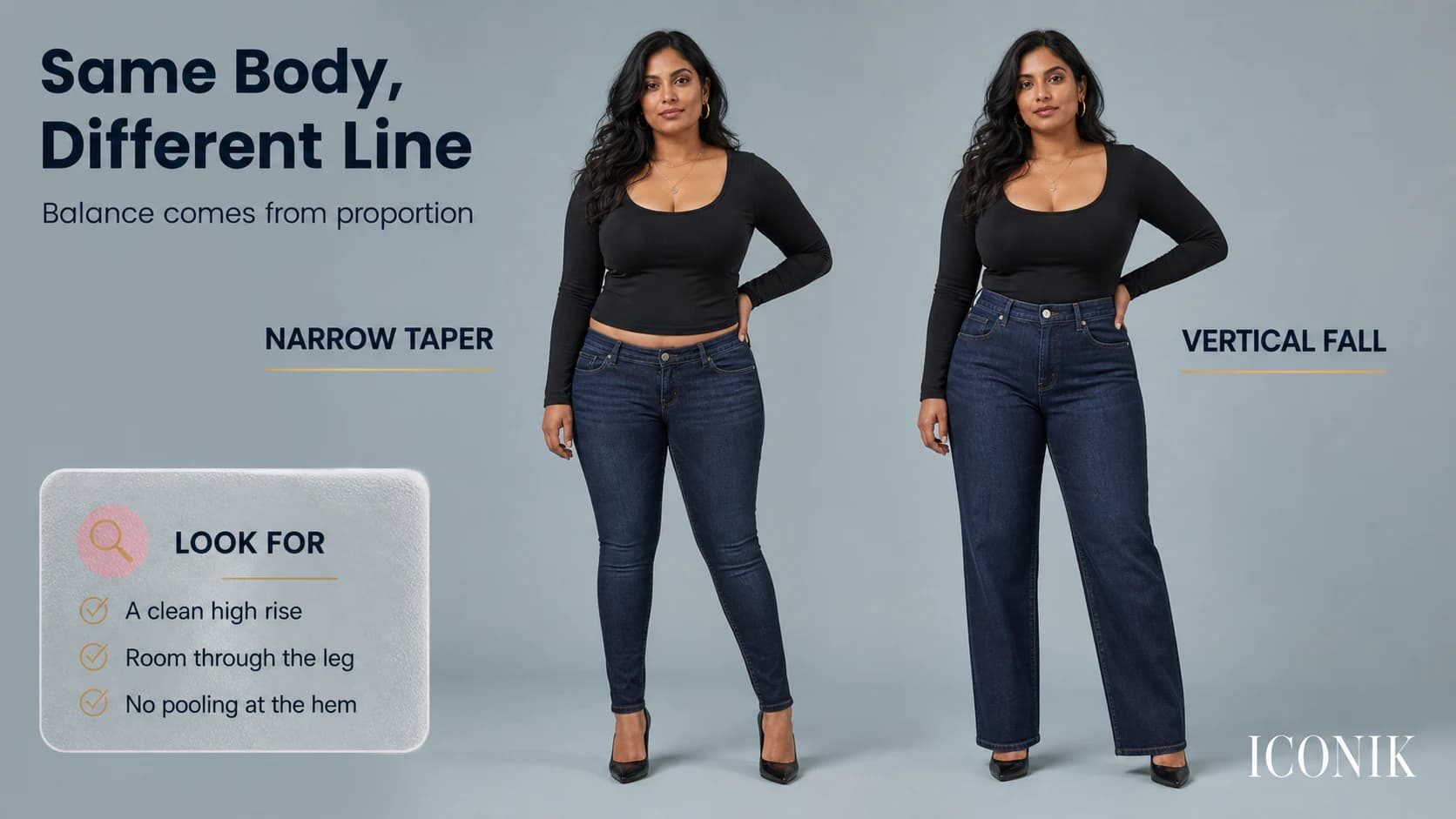
Skinny jeans are not automatically slimming. When the bust, shoulders, arms, or stomach carry more visual volume, an extremely narrow leg can make the lower body recede. The upper body then appears heavier by comparison. The fix is not simply “wear loose jeans”; it is to restore proportion.
Start with a high-rise straight leg, soft bootcut, or wide-straight jean in a clean medium or dark wash. Look for a leg line that leaves the hip without excessive whiskering, holds its direction through the knee, and finishes without stacks. A centre crease or pressed front amplifies the same effect in tailored trousers.
Mechanism 04
Make Top Length, Shoulder Fit, and Layer Direction Work Together
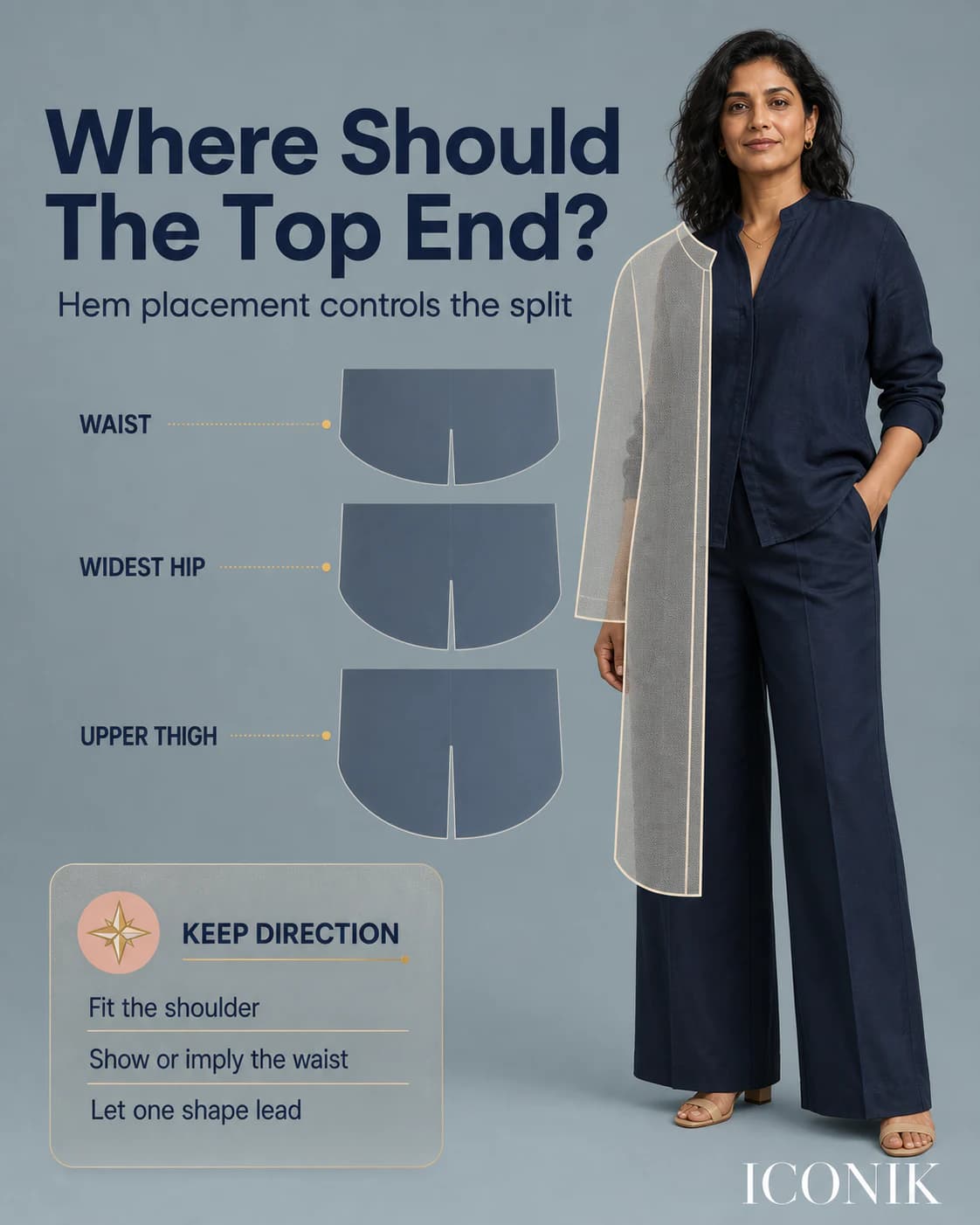
Oversized clothing does not automatically make a shorter woman look shorter. The problem appears when all construction points become ambiguous: the shoulder drops, the sleeve pools, the top ends at the widest hip, the waist disappears, and the trouser stacks. The eye reads width because it cannot find direction.
A relaxed outfit can remain generous while restoring three anchors: an intentional shoulder, a readable waist or vertical opening, and a finished hem. If the top is long and wide, keep the lower line cleaner. If the trouser is wide, use a top that ends or tucks at a deliberate point.
Use the palm test for hems
Move the same top up and down in a mirror by one palm-width. Notice when the leg suddenly appears longer or the hip appears wider. That change tells you more than a generic “petite length” label because it is tied to your actual division points.
Indian wardrobe application
Use the Same Logic for Kurtas, Sarees, Palazzos, and Dupattas
Indian wear contains more line-making elements than most western outfits: kurta hems, side slits, dupattas, borders, pleats, blouse contrast, and jewellery. That gives you more tools, not more restrictions.
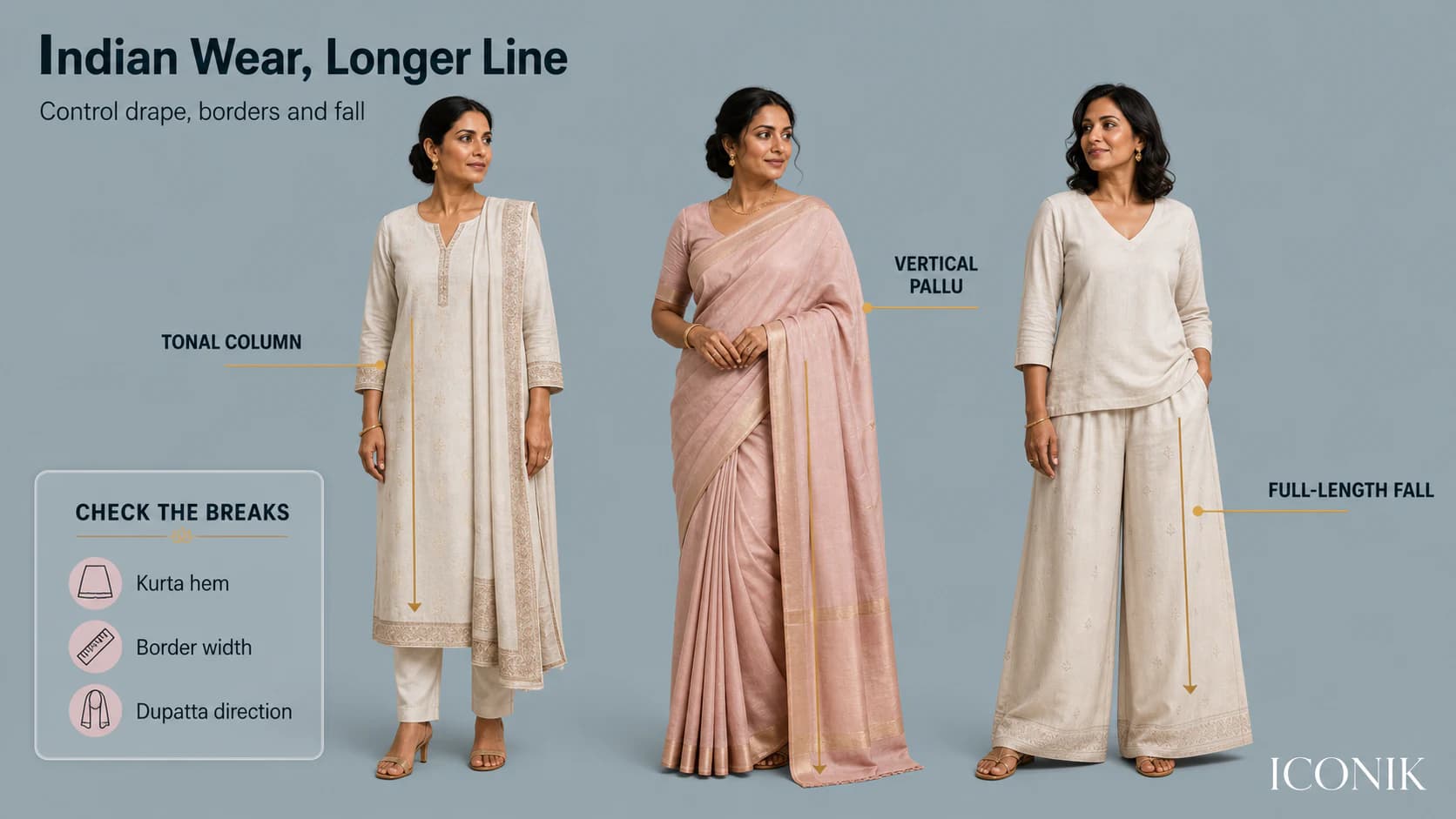
- Kurta sets: compare the kurta hem with the side-slit start. A tonal bottom keeps the lower line visible through the slit.
- Palazzos: choose a clean waistband and a leg that falls from the hip; avoid excess gathering concentrated at the stomach.
- Sarees: use pleat control and pallu direction. A broad contrast border creates a horizontal stop; a quieter border continues the line.
- Dupattas: one long vertical fall usually creates more length than an evenly spread horizontal chest drape.
- Anarkalis: check where the flare begins and whether the scale of the skirt overwhelms the shoulder; floor length alone does not guarantee elongation.
Save this resource
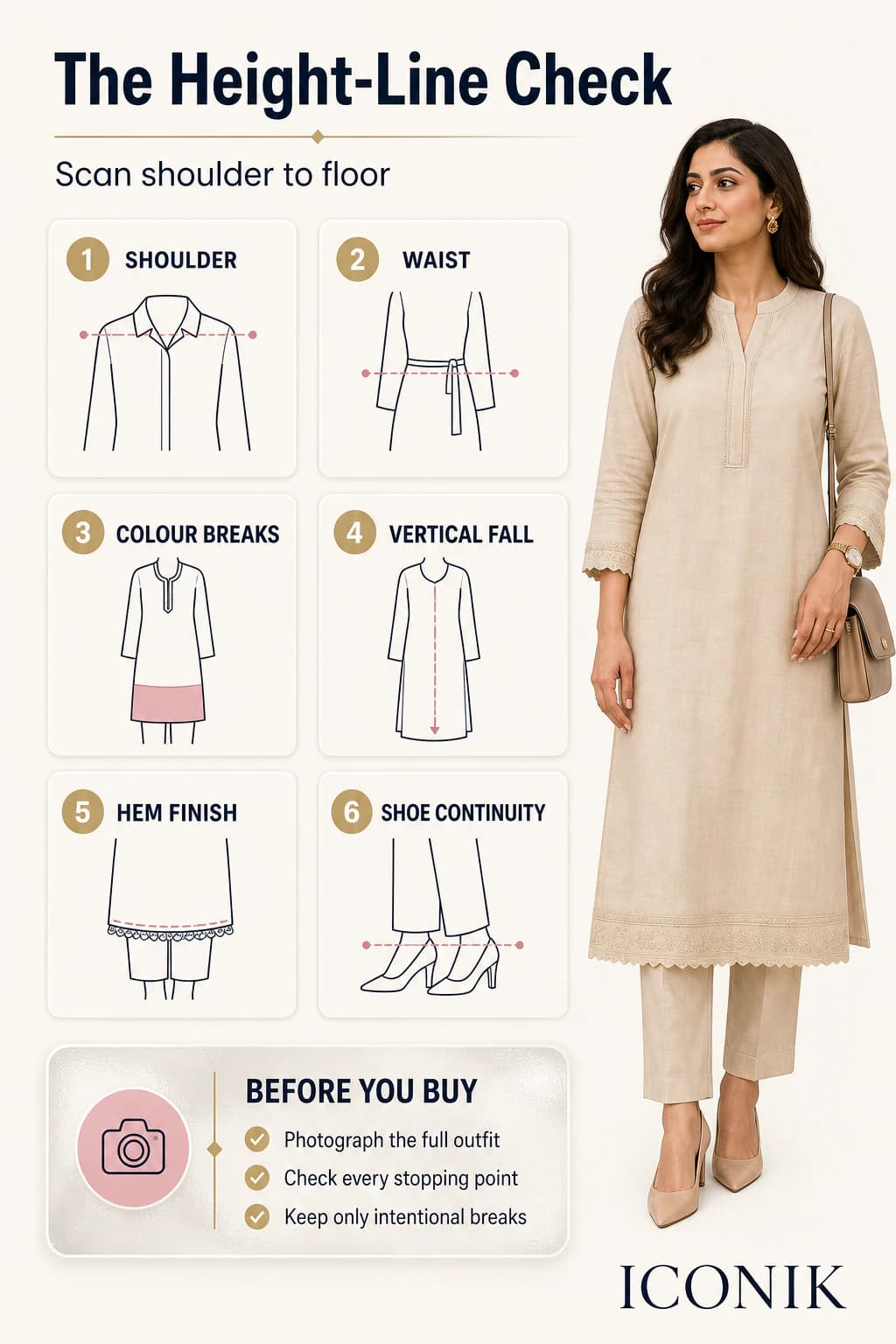
The 60-Second Shopping-Room Checklist
Rule 01
Fit the shoulder
A clear shoulder seam gives the eye a reliable starting point.
Rule 02
Locate the waist
Use the rise, tuck, seam, or crop to show where the legs visually begin.
Rule 03
Reduce random breaks
Repeat or relate colours across the waistband, ankle, and footwear.
Rule 04
Finish the hem
Remove stacking and puddling that compress the lower line.
Rule 05
Choose one lead shape
Let either the top or bottom carry volume instead of making every layer equally wide.
Rule 06
Use open verticals
An unbuttoned shirt, jacket, long shrug, or controlled dupatta creates a central channel.
Rule 07
Scale the print
Narrower repeats usually preserve continuity better than large horizontal motifs.
Rule 08
Keep detail intentional
Place contrast, borders, belts, and embellishment where you want the eye to pause.
Rule 09
Connect the shoe
Relate footwear to the trouser, salwar, saree hem, or visible skin.
Rule 10
Control garment length
Judge hems against your own knee, calf, hip, and waist—not generic petite labels.
Rule 11
Protect the vertical fall
Choose fabric that hangs cleanly instead of clinging, ballooning, or collapsing.
Rule 12
Photograph the full outfit
A mirror crop hides the exact proportion decisions you need to evaluate.
A note on language
Your Body Is Not the Before Picture
“Look taller” is an aesthetic choice, not an obligation. Shortness, width, curves, and softness are not styling errors. The same horizontal border or oversized silhouette that reduces vertical continuity may be exactly right when you want drama, width, or visual ease. Use these mechanisms to control the result—not to make every outfit chase one ideal.
Free proportion test
Find where your height actually sits
The Proportion Code uses your height, waist-to-floor measurement, and inseam to show whether your visual length sits in your torso, legs, or a balanced split—then explains rise, tuck, and crop placement.
Take the Free Proportion Code →