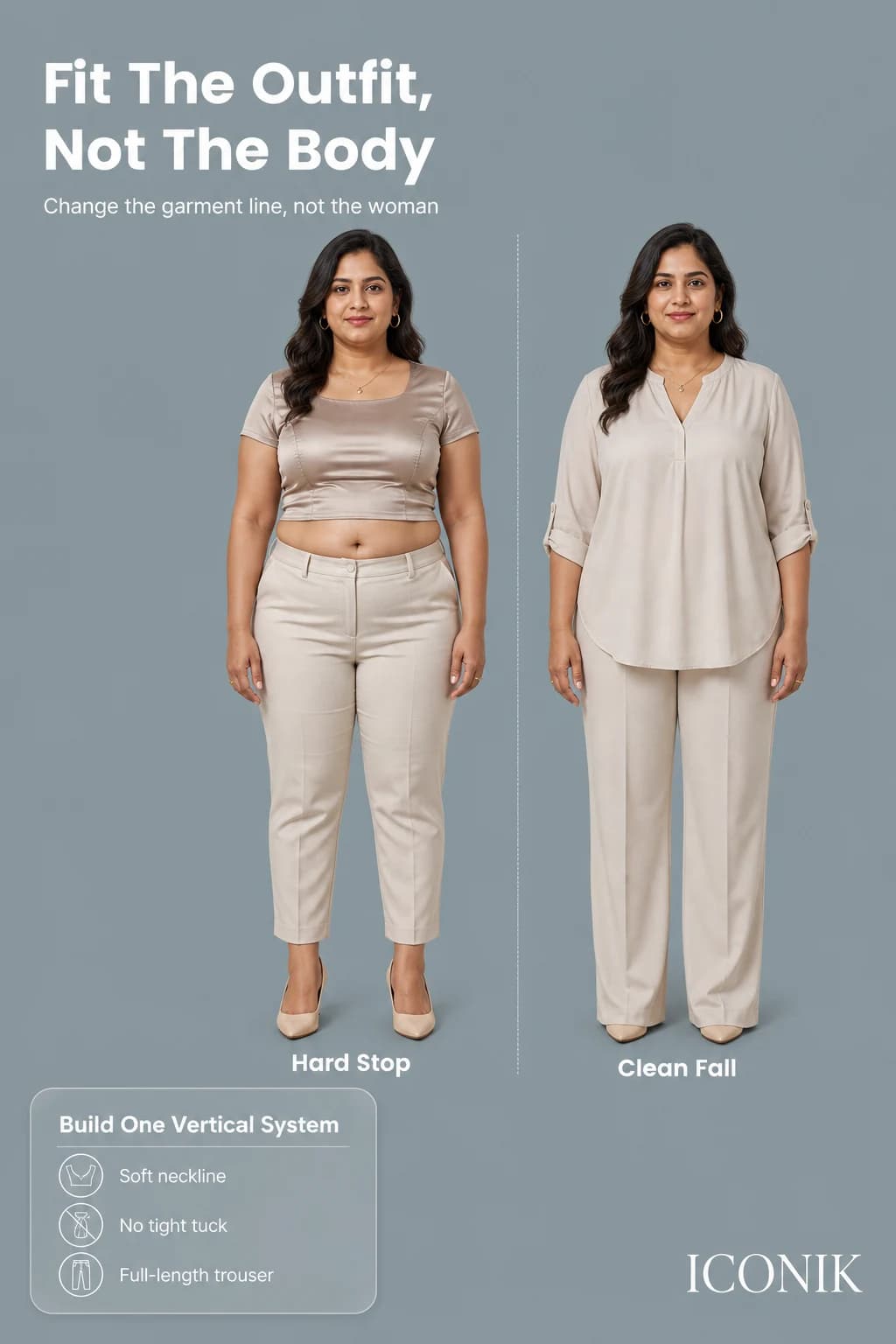
Start with fit—not a promise to “hide” the stomach
Midsection volume can sit high under the bust, around the natural waist, lower on the abdomen, or across several areas. The same garment will behave differently in each case. Begin by checking the garment from the front and side while standing, sitting and reaching.
- Does the fabric pull into horizontal lines across the stomach?
- Does the hem kick forward instead of falling toward the floor?
- Does a waistband roll, dig in or slide down during movement?
- Does the garment fit the stomach but become excessively loose elsewhere?
These are fit observations, not body flaws. Altering the rise, fabric, dart placement, side seam or top length may solve the problem without changing the overall size.
Choose the top length by where the eye stops
A hem creates a horizontal ending. If it finishes at the point where the garment is already projecting or pulling, the eye notices both the hem and the tension together. Moving the hem a little higher or lower can produce a calmer result.
Test three landmarks: just below the waistband, upper thigh, and below the fullest part of the hip. The best option is the one that hangs cleanly with your chosen bottom. A longer top is not automatically better; it can shorten the visible leg or add fabric where you do not want it.
Necklines also influence the route of attention. An open, soft V, scoop, split neck or controlled collar can frame the face and keep the upper body visually intentional. Choose by face framing and comfort rather than a rule that one neckline “slims.”
Palazzos work only when the top and waistband cooperate
A wide trouser can create a long lower-body line, but it cannot compensate for a top that grips the stomach or ends at the point of greatest tension. Judge the top, rise and trouser width as one system.
- Look for a waistband that stays level and secure without requiring a very tight tuck.
- Let the trouser fall from the hip instead of widening abruptly from a bulky waistband.
- Use full length when practical so the vertical line reaches the shoe.
- Pair volume below with a top that has controlled ease—not cling and not excess bulk.
Straight-leg and soft bootcut trousers can provide the same balancing effect with less volume. The useful cut is the one that works with your torso, footwear and daily movement.
Indian wear: coordinate the yoke, flare, slit and drape
Straight and softly shaped kurtas
Look for enough room through the stomach for the front to hang without catching. A vertical seam, placket or open neckline can support direction, while side slits should begin where they allow the fabric to move rather than pull.
A-line and Anarkali shapes
These can work when the yoke ends at a comfortable point and the flare begins without gathering heavily over the stomach. Compare a low-volume A-line with a gathered Anarkali; more flare does not automatically create a cleaner silhouette.
Sarees
Focus on comfort at the petticoat or underskirt, the bulk and direction of the pleats, and how securely the pallu sits. A fluid or softly structured fabric may be easier to distribute than a very stiff or slippery one, but the drape technique matters as much as the textile.
Test fabric behaviour instead of shopping by fibre name
Two fabrics with the same label can behave differently because of weave, weight, stretch and finishing. Hold the garment from the shoulder and watch whether it falls, collapses or stands away from the body.
- Usually easier: medium-light fabrics with fluid or softly structured drape and enough opacity.
- Test carefully: thin clingy knits, stiff fabric with no shaping, and shiny textiles placed under tension.
- Check in motion: sit for several minutes, then stand and see whether the fabric releases or remains caught.
Use colour and print to support the outfit hierarchy
Dark colour is one option, not an obligation. A low-contrast column can make the eye travel continuously, while a brighter neckline, scarf, jewellery or layer can establish a clear focal point near the face.
With print, inspect placement rather than banning a scale. A large motif centred on the stomach behaves differently from the same motif distributed across the whole garment. Vertical spacing, an open ground and a print that continues past the waist can feel less interruptive than a dense horizontal band.
The final question is not whether an outfit makes the stomach disappear. It is whether the complete look feels intentional, comfortable and appropriate for where you are going.
For broader silhouette guidance, read the Geometric Silhouette Profiling methodology.