Saree Draping for Your Body Type: The Complete Guide
The saree is one of the most silhouette-adaptable garments in existence — the same six yards can be draped to elongate, add volume, define the waist, or balance proportions. The secret is knowing which adjustments serve your specific body type. This guide gives you body-type-specific draping techniques, blouse guidance, and pallu placement for all five silhouettes.
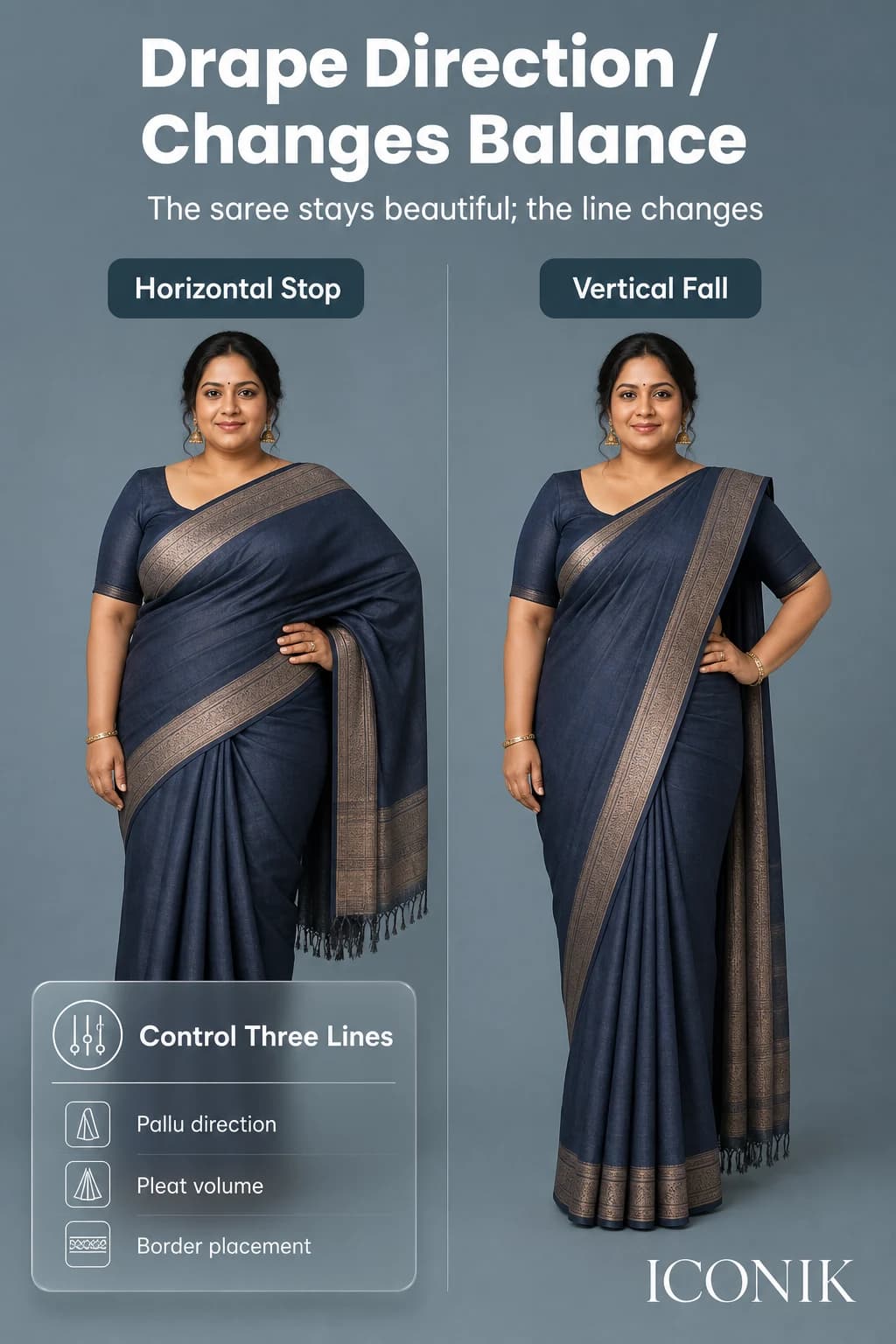
The Three Variables That Determine How a Saree Looks
Before the silhouette-specific guidance, the three universal variables that affect how any saree looks on any body:
- Petticoat position: Tied at the natural waist (most elongating) vs higher (creates horizontal break). The petticoat waistband should always be hidden by the saree — visible waistbands add bulk at the midsection.
- Pallu position: Draped vertically over the shoulder (elongating, slimming) vs spread horizontally across the chest (adds width). Pinned vs free-hanging (practical vs formal).
- Blouse length and neckline: The blouse hem at the natural waist creates the cleanest silhouette. The neckline type follows face shape and body type guidelines.
Apple Body Type: Saree Draping Formula
The goal for an apple silhouette: create a vertical line through the midsection and draw attention to the face and décolletage rather than the waist area.
- Choose a solid-colour saree or a saree with a minimal, tonal print — avoid bold horizontal borders at the hip
- Pleat count: fewer, wider pleats for a cleaner fall over the midsection
- Pallu: over the left shoulder, draped as a clean vertical fall — pinned at the shoulder, not fanned out
- Blouse: boat neck or V-neck, ending exactly at the natural waist
- Avoid: crop blouses that expose the midsection; heavy embroidery at the hip
Pear Body Type: Saree Draping Formula
The goal for a pear silhouette: add visual interest and weight to the upper body; keep the lower body visually quiet.
- Choose a saree with a heavy, embellished pallu — the visual weight at the shoulder and chest balances wide hips
- Blouse: embellished, contrasting, or structured to draw the eye upward — this is where all the visual interest should sit
- Pallu: draped across the chest, fanned or pinned at the shoulder to create upper body volume
- Skirt section: plain, minimal border, solid colour
- The contrast principle: embellished or printed blouse + plain saree body = visual balance for pear proportions
Rectangle Body Type: Saree Draping Formula
The goal for a rectangle silhouette: create waist definition where none exists naturally.
- A saree with a contrasting blouse creates a visual waist break — the colour change at the waist defines the waist line
- Blouse: cropped or ending exactly at the natural waist; a fitted blouse with a structured bodice creates shape
- A thin belt or waist chain over the saree at the natural waist is increasingly popular and highly effective for rectangle proportions
- Pallu: draped asymmetrically — one side higher than the other creates an asymmetry that visually implies a waist
Hourglass Body Type: Saree Draping Formula
The goal for an hourglass silhouette: honour the natural shape without obscuring it.
- Any draping style works — the hourglass silhouette is naturally saree-flattering
- Avoid: oversizing the drape or adding excessive fabric at the waist — the saree should follow the natural curve, not pad it
- Blouse: fitted at the bust and waist — a structured blouse that follows the curve is ideal
- The classic Nivi drape with a fitted blouse is the most elegant choice
Inverted Triangle Body Type: Saree Draping Formula
The goal for an inverted triangle: add visual volume at the hips to balance wide shoulders.
- Choose a saree with a heavy embellished border at the hem — adds visual weight at the bottom
- Draping styles that add volume: the Gujarati or Sindhi drape — both bring the pallu to the front and add volume across the hip area
- Blouse: plain, minimal — a simple V-neck or round-neck blouse. No boat neck (adds shoulder width).
- Pallu: draped to fall at the front rather than over the shoulder — this adds hip and lower body visual weight
Frequently Asked Questions
Which saree draping style makes you look slimmer?
The Nivi drape (the most common draping style, where the pallu falls over the left shoulder) with the pallu styled as a vertical fall — hanging straight down from the shoulder rather than spread horizontally across the chest — creates a strong vertical line. Combined with a solid-colour saree without a contrasting border, this creates the most elongating, slimming effect.
What is the best petticoat height for creating a taller silhouette?
Tie the petticoat at the natural waist — not above it. A petticoat tied above the natural waist creates a high horizontal line that shortens the torso and creates a matronly silhouette. At the natural waist, the full length of the saree falls vertically from the hip, creating maximum elongation.
How should a pear-shaped woman drape her pallu?
The pallu should be styled to create visual interest and volume at the upper body — draping the pallu across the front at chest level, or pinning it at the shoulder with a brooch and allowing it to fan out slightly across the chest. This draws the eye upward and balances wide hips with upper body visual weight.
What blouse length works best for a short torso when wearing a saree?
The blouse hem should sit exactly at the natural waist — not cropped above it. A gap of skin between the blouse hem and the petticoat waistband creates a visual horizontal break that makes the torso look shorter. Blouses that end precisely at the natural waist, with the petticoat waistband hidden, create the cleanest, most elongating effect for short torsos.
Related Guides
Want your complete saree formula?
Your Iconik Style Blueprint includes body-type-specific saree draping guidance, blouse neckline formulas, and undertone-matched colour recommendations.
Get My Style Blueprint — ₹2,699Cite this guide:
Iconik Styling Team. "Saree Draping for Your Body Type: The Complete Guide." Iconik LLP, 2025. https://www.iconik.pro/style-guides/saree-draping-body-type