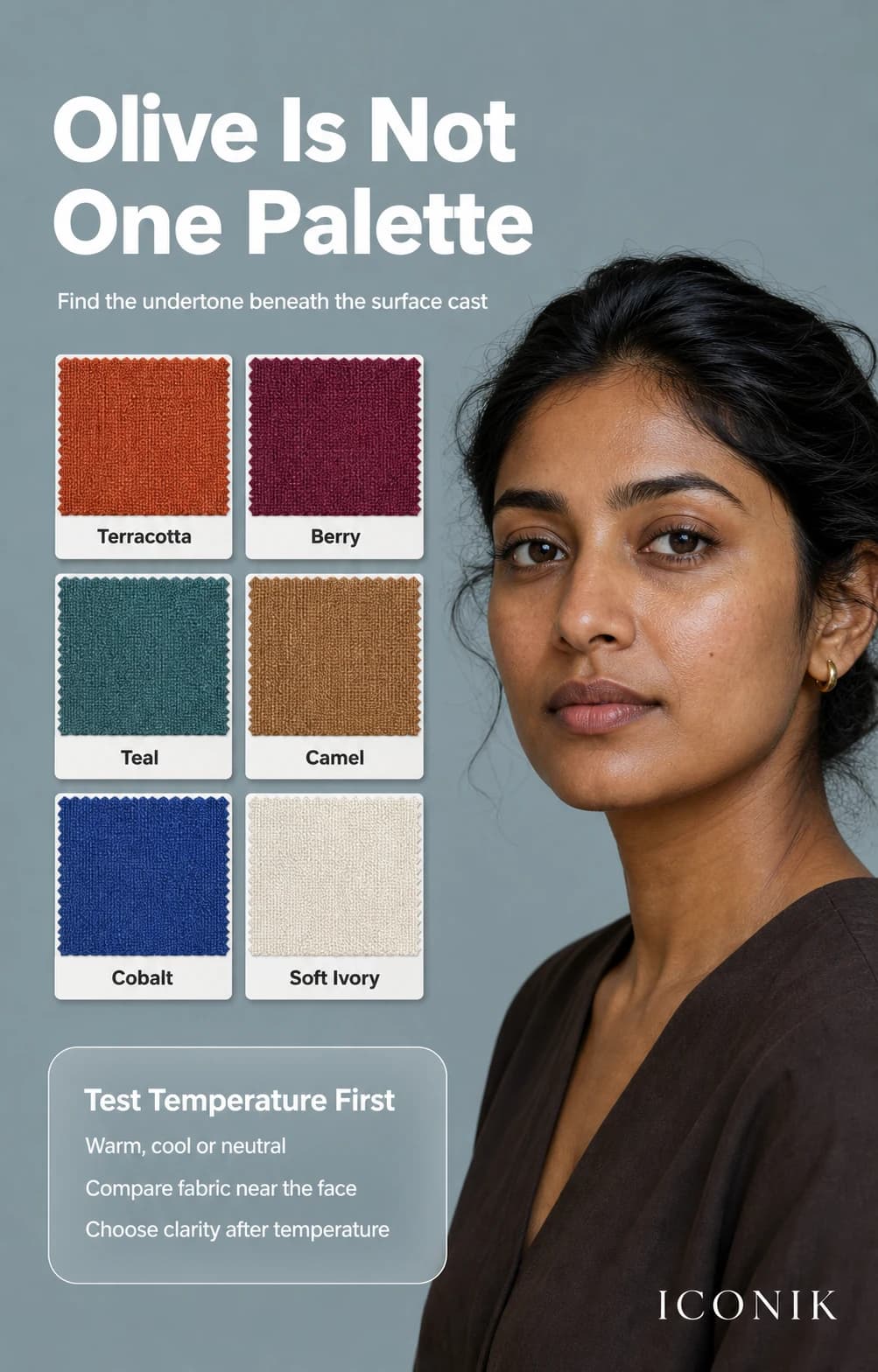
What Is Olive Skin — and Why It Is Not an Undertone
Olive skin describes a greenish or greyish-green cast on the surface of the skin. It is particularly common in South Asian, Southeast Asian, Mediterranean, and Middle Eastern women. The olive quality is caused by a combination of melanin pigment and carotenoids (yellow-orange pigments from diet) that together create a slightly muted, greenish-toned surface appearance.
This surface cast is distinct from undertone. Undertone is the warm (yellow/golden/peachy), cool (pink/blue/rosy), or neutral base pigment of the skin — the colour that comes through from beneath. Olive is a surface characteristic; undertone is a depth characteristic. They are different variables.
The practical consequence: if you have olive skin and someone tells you "olive is a warm undertone," they may be wrong about you specifically. Your olive surface tone can sit on top of a warm, cool, or neutral undertone — and the wrong palette advice, based on treating all olive skin as warm, will look consistently off without you being able to explain why.
How to Identify Your Undertone Within Olive Skin
Standard undertone tests are less reliable on olive skin because the greenish surface cast interferes. The most reliable methods for olive skin:
The fabric draping test (most reliable for olive skin)
In natural daylight, hold a warm-toned fabric (golden yellow, terracotta) next to your bare face, then a cool-toned fabric (cobalt blue, fuchsia). One will make your complexion look brighter and more alive; the other will make it look slightly dull or greenish. The fabric that makes you look better indicates your undertone.
The gold vs silver test
Hold gold jewellery, then silver, against your inner wrist in natural light. Warm olive undertone: gold looks harmonious, silver looks slightly stark or cool. Cool olive undertone: silver looks clean and bright, gold looks yellowish or warm. Neutral: both look equally flattering.
The sun reaction test
Warm olive skin tends to tan easily and deeply with sun exposure. Cool olive skin may burn slightly before tanning, or tan without burning but remain lighter than warm olive skin at the same depth. This is a supplementary indicator only — use it alongside the draping or jewellery test.
See the full undertone identification guide: How to Find Your Undertone at Home.
Best Colours for Olive Skin with Warm Undertone
Warm olive skin responds to golden, earthy, and rich warm colours. These harmonise with both the surface olive quality and the warm undertone beneath it, creating a cohesive glow.
Deep Terracotta and Rust
The single most flattering colour for warm olive skin — brings out the golden-earthy quality of the complexion
Forest and Olive Green
Harmonises directly with the surface olive pigment while warming the overall look
Mustard and Deep Amber
The golden warmth in mustard echoes the warm undertone and lifts the complexion
Rich Burgundy (warm-toned)
A red-brown burgundy — not the blue-based version — is deeply flattering on warm olive skin
Warm Bronze and Copper
Metallic tones that echo the warmth without being bright gold
Deep Chocolate Brown
Earthy and rich — particularly flattering in silk and structured fabrics
Warm Coral
Orange-based coral (not pink-based) works well — choose one with visible warmth, not a pink cast
Camel and Warm Tan
Neutral but warm — understated and very harmonious against olive skin with warm undertone
Best Colours for Olive Skin with Cool Undertone
Cool olive skin has an interesting quality: the blue-pink undertone beneath the greenish surface creates a complex, unusual complexion that responds best to saturated cool colours. These cut through the surface olive cast and make the skin look luminous rather than dull.
Royal Blue and Cobalt
Works exceptionally well — the strong cool hue cuts through the olive surface cast and creates striking contrast
Deep Fuchsia and Magenta
Blue-based pinks are one of the most flattering colours for cool olive skin
Emerald Green
Blue-based green — harmonises with both the cool undertone and the olive surface pigment
Deep Plum and Aubergine
Rich, jewel-toned purples work beautifully for cool olive skin
Teal
Blue-green — harmonises with the olive surface tone while reinforcing the cool undertone
Berry Red and Deep Crimson
Blue-based reds, not orange-based — the cool version of red works for cool olive undertone
Charcoal and Deep Navy
Stronger for cool olive skin than black — these provide contrast with a cool quality
Cool White
True white (not cream) — the cool quality cuts through the olive surface rather than dulling it
Best Colours for Olive Skin with Neutral Undertone
Neutral olive skin has flexibility across both palettes, but tends to look best in slightly muted, complex colours — those with some grey or depth rather than pure bright saturation. The greenish surface tone plus a balanced undertone creates a complexion that suits sophisticated, nuanced colours particularly well.
Muted Teal
Greyed teal — one of the most universally flattering colours for neutral olive skin
Dusty Rose
Muted pink — bridges warm and cool without emphasising either
Warm Taupe and Greige
Sophisticated neutrals that harmonise with the olive surface quality
Soft Olive and Sage
Muted greens that echo the surface tone — flattering rather than clashing
Mauve
A complex colour that sits between warm and cool — suits neutral olive skin well
Slate Blue
Greyed blue — cooler than teal but muted enough for neutral undertone