Best Colours for Dark Skin Indian Women
The best colours for dark skin Indian women are not a single list — they depend on your undertone. Two women with equally deep skin tones can have completely different undertones, which means completely different colour palettes. This guide covers how to find your undertone and which colours will genuinely flatter your skin.
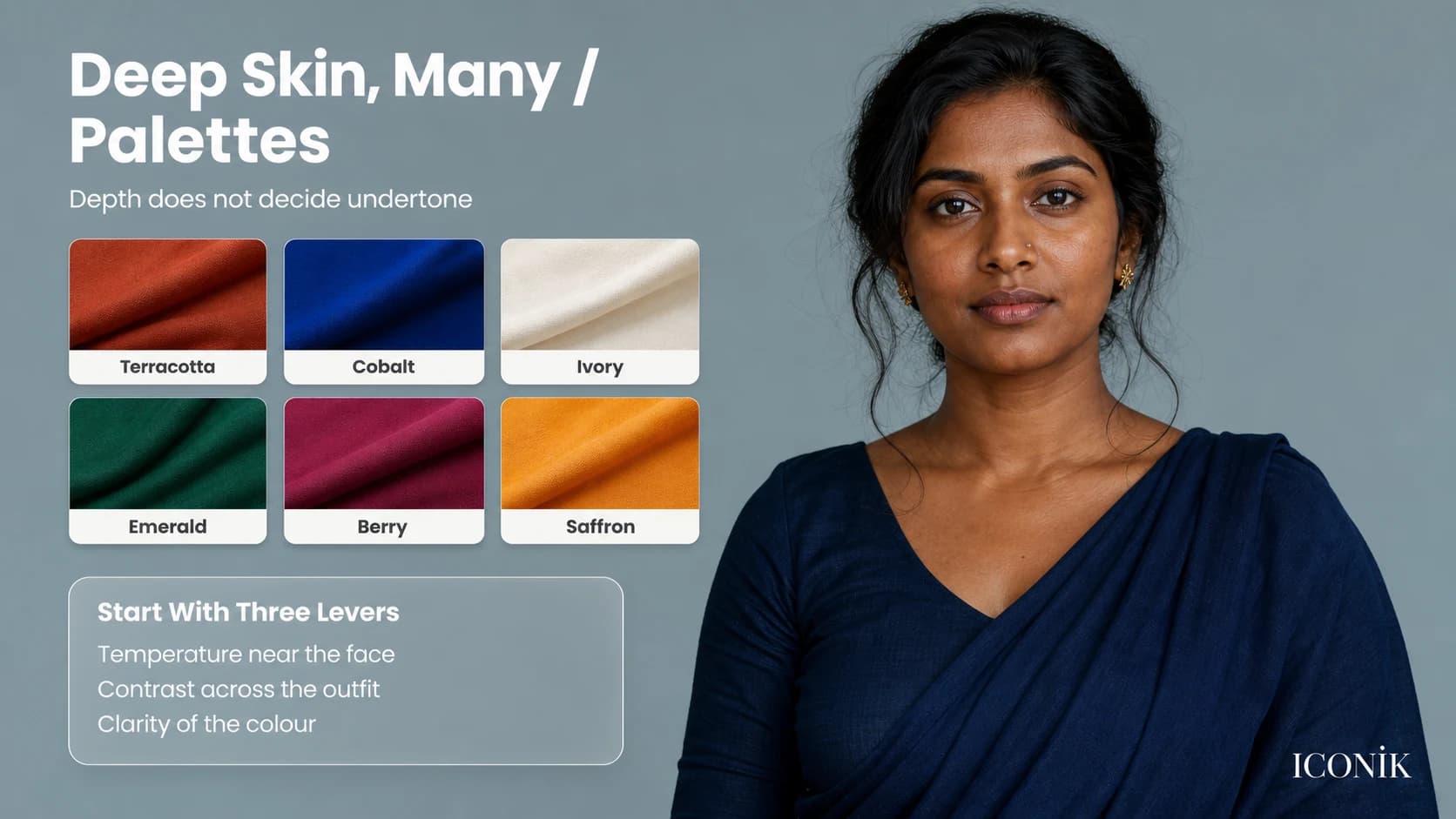
The Most Important Thing to Understand
Skin depth (how dark or light your skin is) and skin undertone (the warm, cool, or neutral quality beneath the surface) are two different things. Dark skin does not automatically mean warm undertone — many women with deep skin have distinctly cool undertones.
The colours that will genuinely flatter you are determined primarily by your undertone, not your skin depth. Getting the undertone right is step one.
Additionally: Deep skin can create striking contrast with light and bright colours. Saturated colours are useful, but intensity still needs to match the wearer's undertone and natural contrast. Pastels are not prohibited; some need clearer colour or intentional contrast elsewhere in the outfit.
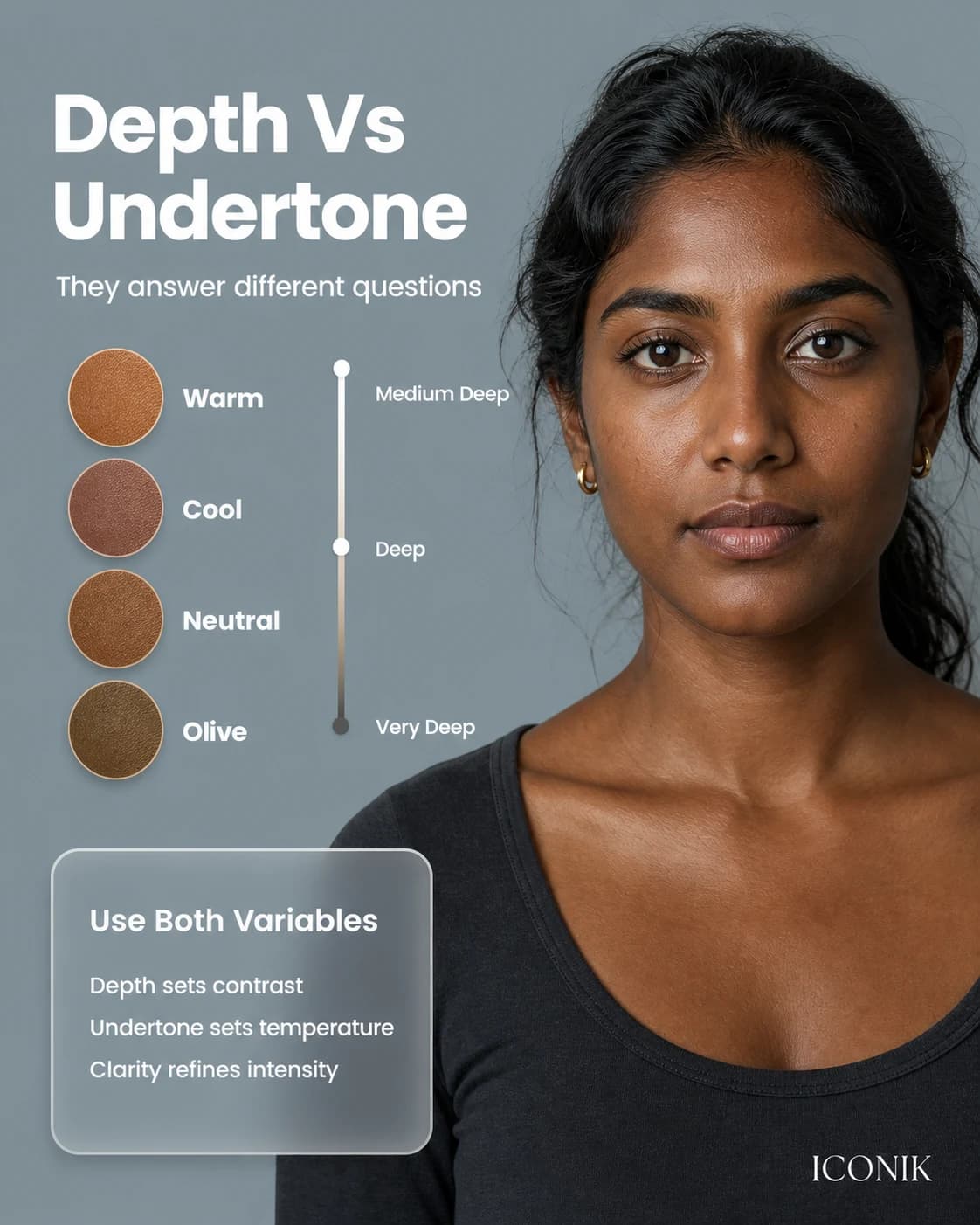
How to Find Your Undertone With Dark Skin
Vein colour, jewellery preference and white-paper tests can be ambiguous on any skin depth. A controlled fabric comparison is more useful because it tests the actual decision you are making: what happens when a colour sits close to your face.
The Fabric Draping Method
- Stand in indirect daylight and turn off strongly coloured indoor lights.
- Keep your face, camera position and exposure unchanged; remove dominant makeup and large jewellery.
- Compare one pair at a time: warm ivory versus crisp white, terracotta versus cobalt, then gold-toned versus silver-toned fabric.
- Ignore which fabric you like more. Watch the eyes, lips, under-eye shadows, jawline and overall evenness of the face.
- Repeat the winning colours on a second day. One comparison is a clue; a repeated pattern is more useful.
Record the pattern rather than forcing a label:
- Warm-leaning pattern: warm ivory, terracotta and olive repeatedly create more facial clarity than their cooler comparison colours.
- Cool-leaning pattern: crisp white, cobalt, berry or cool emerald repeatedly look cleaner near the face.
- Neutral or olive pattern: temperature results are mixed, while clarity and the amount of grey in a colour make a larger difference.
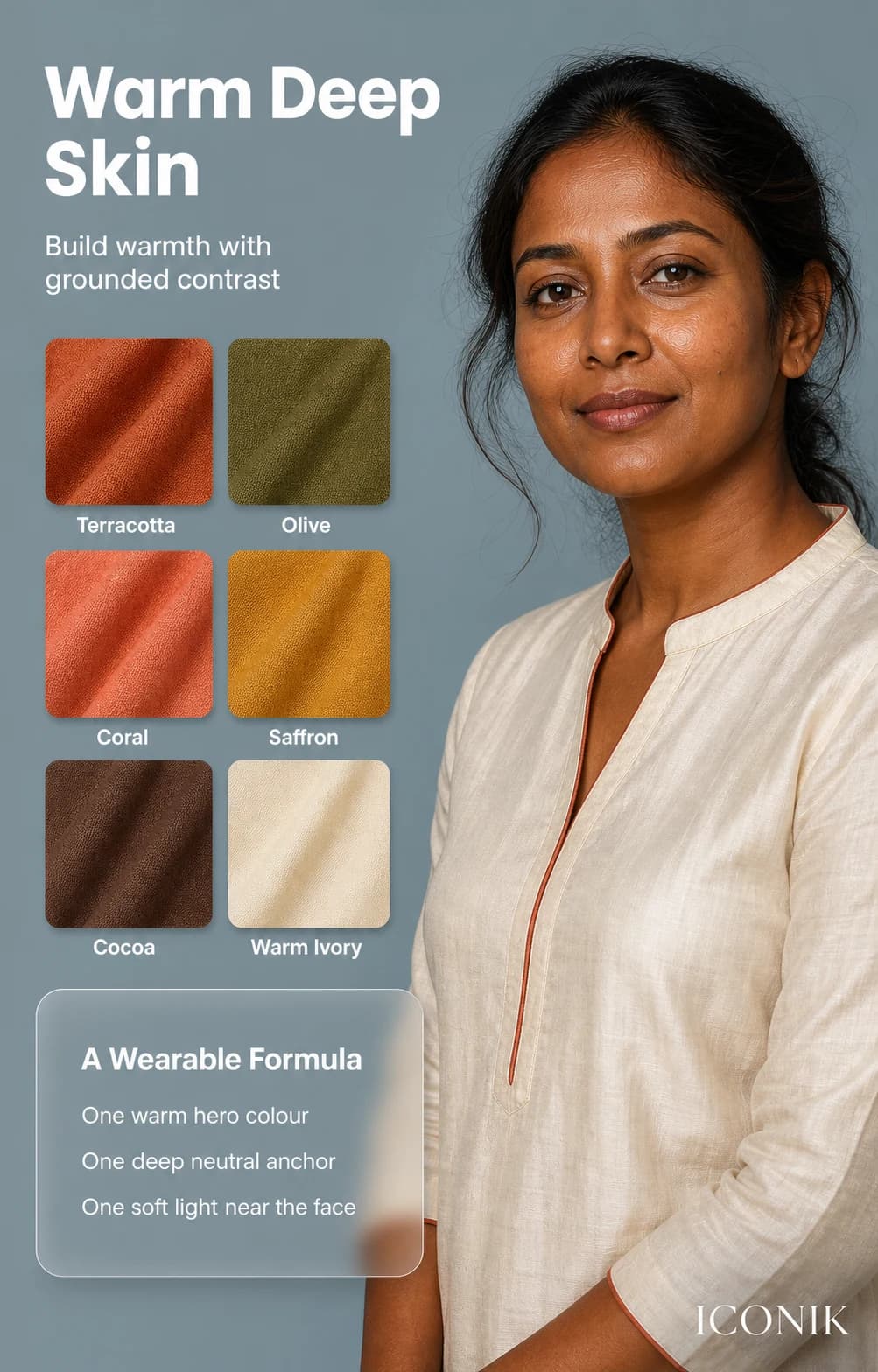
Best Colours for Warm Dark Skin
Use the list below as a testing rail, not a permission system. Warm deep skin often supports earthy reds, golden greens and warm lights, but the best version still depends on whether your colouring prefers softness or clarity.
Your Best Colours
How to rescue a difficult colour
If cobalt, lavender or a cool grey feels disconnected near the face, move it to trousers, a bag or footwear and place warm ivory, olive, coral or your preferred metal closer to the face. You do not need to discard an entire colour family.
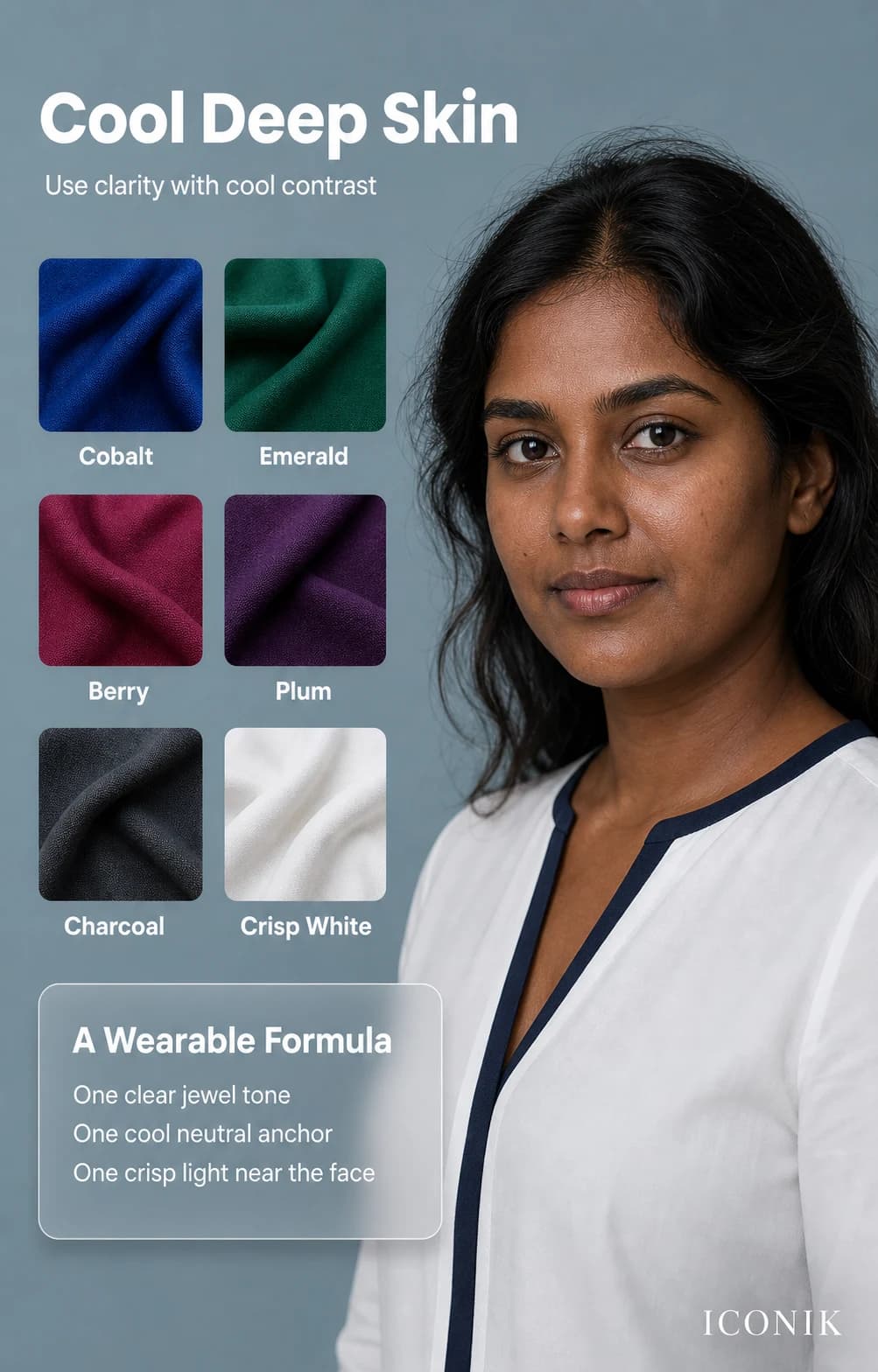
Best Colours for Cool Dark Skin
Cool deep skin often works well with clear blues, blue-greens, berries and cool neutrals. If the brightest version overpowers you, keep the temperature and reduce the intensity rather than switching to a warm colour automatically.
Your Best Colours
How to rescue a difficult colour
Warm mustard, camel or orange can move away from the face or be separated by a crisp white, navy, berry or charcoal neckline. Jewellery is a finishing variable, not a diagnosis: compare metals against the complete outfit.
What About Neutral or Olive Deep Skin?
Neutral does not automatically mean muted, and olive does not automatically mean warm. If gold-versus-silver tests feel inconclusive, compare pink against olive, then compare soft colour against clear colour. The more useful question may be how much yellow, grey or brightness the face can carry.
- Balanced anchors: soft navy, cocoa, stone, charcoal and aubergine.
- Useful comparison colours: dusty rose versus coral, muted teal versus olive, crisp white versus ivory.
- Metal test: compare polished and brushed finishes as well as warm and cool metals; reflectiveness can matter as much as temperature.
If a colour flattens facial definition, restore contrast with a deeper neckline, jacket, dupatta, bag or lip colour before rejecting the whole family.
Can Dark Skin Wear Pastels?
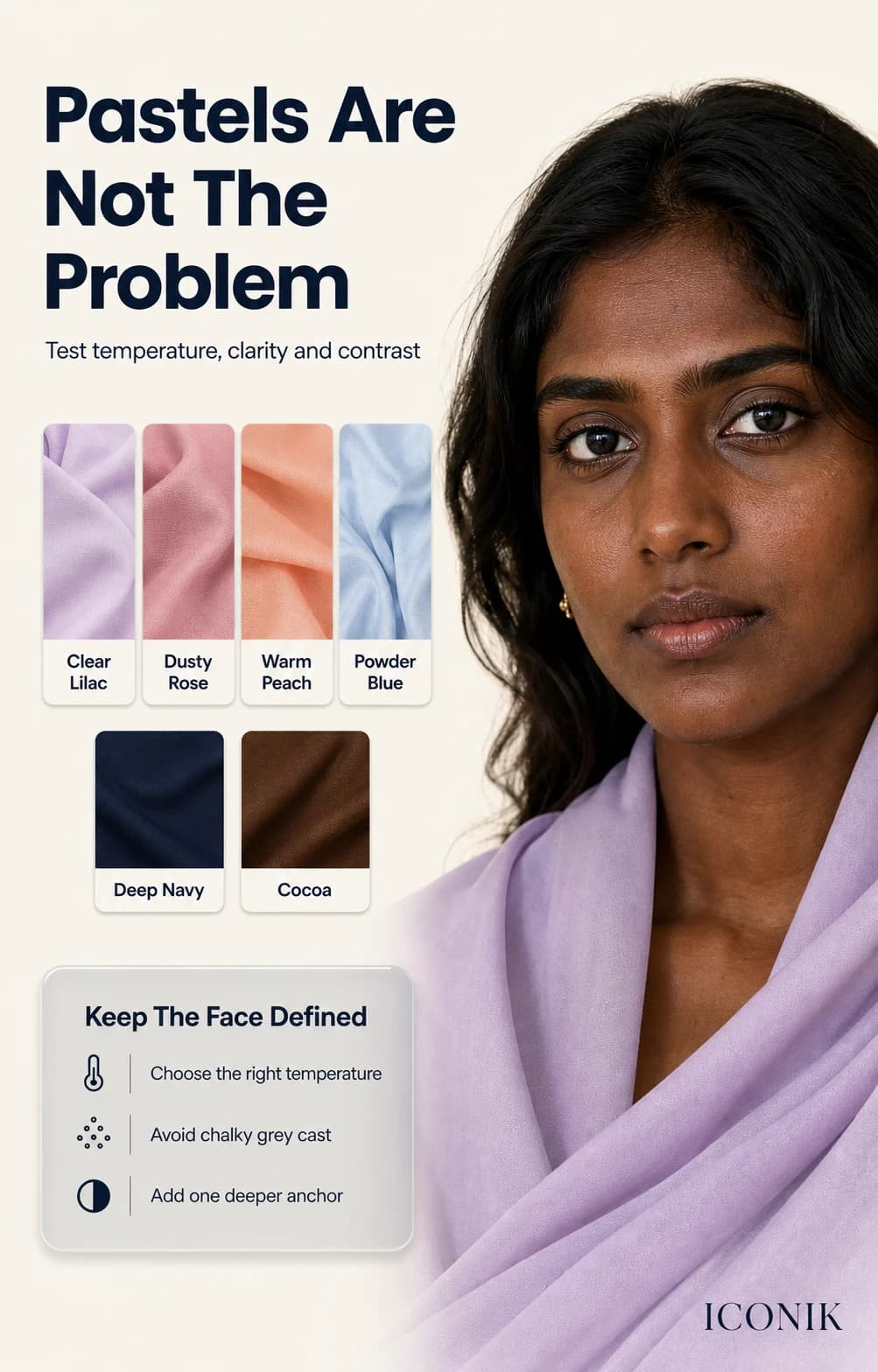
Yes. A pastel is simply a colour mixed with a large amount of white; it is not reserved for light skin. The failure point is often a chalky grey cast, an incompatible temperature or too little definition in the complete outfit.
Compare clear lilac with dusty lavender, powder blue with blue-grey, and warm peach with icy pink. If the face looks less defined, try a clearer version or add one deeper anchor such as navy, cocoa, berry or forest green.
Pastel sarees and kurtas can also gain definition through a deeper blouse, border, dupatta, bag or neckline. Evaluate the entire near-face composition rather than judging the fabric in isolation.
Which White and Jewellery Metal Should You Choose?
Compare crisp white, soft white and warm ivory in the same light. Crisp white creates the strongest edge; ivory softens the transition; soft white sits between them. Keep the version that sharpens the eyes and lips without making shadows look greyer, yellower or redder.
For jewellery, compare equal-size pieces with similar shine. A polished silver earring reflects more light than a brushed gold earring, so finish can distort a simple warm-versus-cool test. Judge the metal with the neckline and outfit colour you will actually wear.
How to Build a Complete Outfit Instead of Collecting Colour Lists
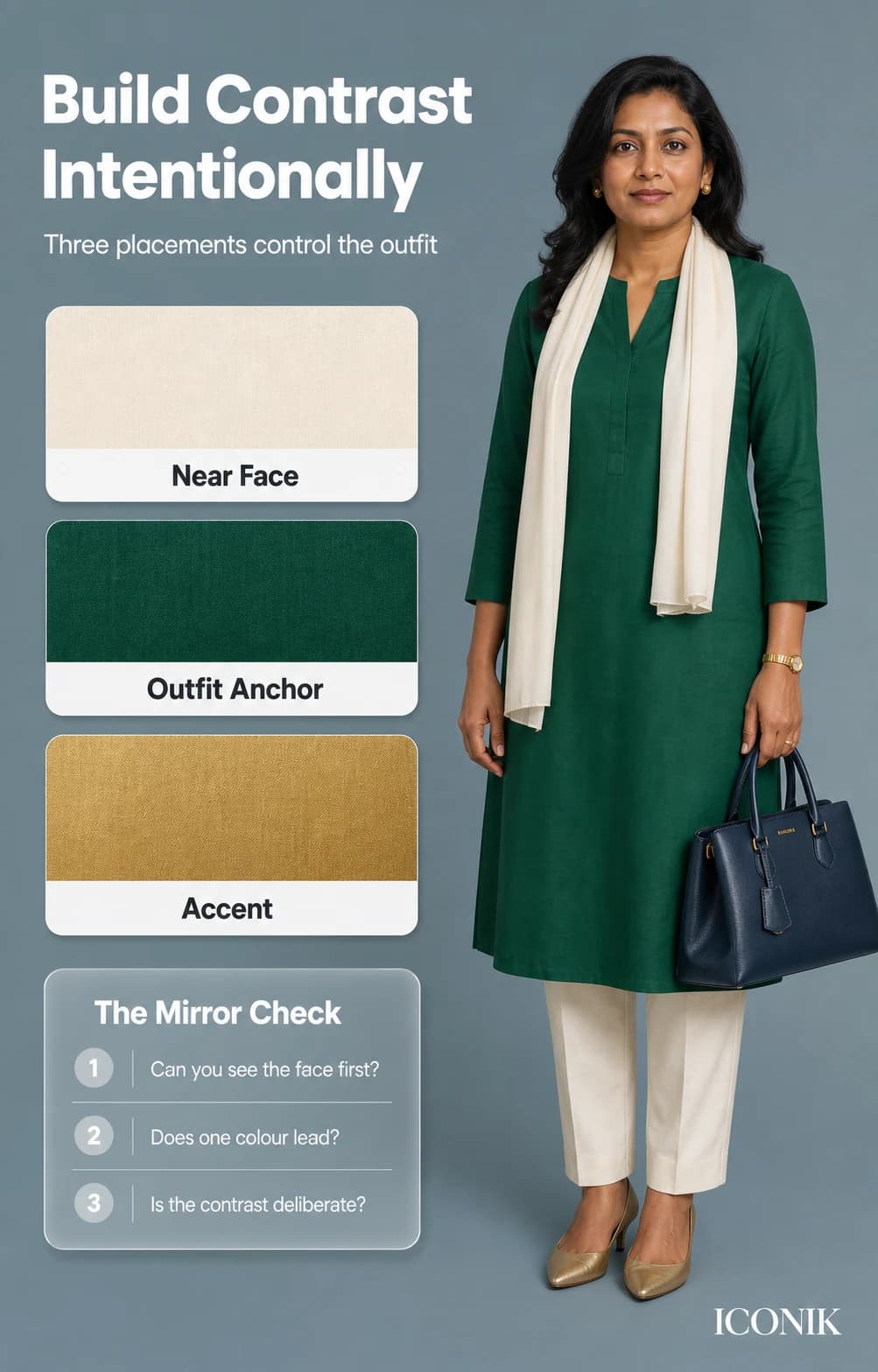
- Choose the near-face colour: blouse, kurta, scarf, dupatta, jacket lapel or saree pallu.
- Add one anchor: navy, cocoa, charcoal, ivory or another neutral that controls the outfit's contrast.
- Place one accent: jewellery, bag, border, footwear or lip colour. It should support the lead colour rather than compete with it.
- Take a mirror photo: if the garment is noticed before the face, reduce either brightness, pattern scale or the number of competing accents.
How to Apply the Palette to Indian Wear
Indian wear adds border, blouse, dupatta, embroidery and metalwork to the colour decision. Use those parts strategically instead of asking whether one saree or kurta colour is universally flattering.
- Saree: the blouse and pallu sit closest to the face; test them before judging the body colour.
- Kurta set: use a tonal trouser for length, then let the dupatta or neckline provide the near-face colour.
- Occasion wear: balance rich fabric, embroidery and jewellery so only one element becomes the visual hero.
- Pastel Indian wear: add definition through a deeper border, blouse, bag or metal rather than abandoning the pastel.
Frequently Asked Questions
What colours look best on dark skin Indian women?
Start with undertone, then refine by clarity and contrast. Warm deep skin often works with terracotta, olive, coral, cocoa and warm ivory; cool deep skin often works with cobalt, emerald, berry, plum, charcoal and crisp white.
Do bright colours work for dark skin Indian women?
Yes — bright colours work very well because deep skin provides a high-contrast base that makes vibrant colours appear vivid. Choose brights in your undertone direction: jewel tones for cool skin, warm brights for warm skin.
Should Indian women with dark skin avoid white?
No. Compare crisp white, soft white and warm ivory in the same daylight. Keep the version that makes the eyes, lips and skin appear clearest.
Can dark skin Indian women wear pastels?
Yes. Pastels work best when their undertone is compatible and the outfit preserves enough contrast near the face. Compare a clear lilac with dusty lavender, or warm peach with icy pink, and keep the version that makes the eyes and skin appear clearer.
What is the difference between dark skin and dusky skin in colour analysis?
They are subjective appearance terms, not scientific colour categories. Everyday usage may use dusky for medium-to-deep brown and dark for a deeper brown complexion, but neither term predicts undertone or one correct palette.
Free three-minute diagnostic
Compare colours from your own wardrobe
Use the Glow Test to compare tops, dupattas, scarves, or saree fabrics in the same daylight and score clarity, lift, shadows, and dullness.
Take the Free Glow Test →Cite this guide: Rana, Jasmine. “Best Clothing Colours for Dark Indian Skin by Undertone.” Iconik. Updated 23 July 2026.